Pagan Theology
Pagan theology: Down the Wookey Hole
The English town of Wells in the county of Somerset, England is a few minutes north of Glastonbury. It is home to the great Wells cathedral and sits in the middle of some charming English countryside. The whole region is resplendent with Pagan sites, from Glastonbury tor (Wells also has a tor) to the springs of the Goddess Sulis-Minerva at Bath, to the nearby Salisbury Plain with the Stonehenge and Avesbury circles. It also has an interesting geology, being associated with the same limestone formations that produce the springs at Bath. Wells also has three “wells” or springs, two of them on the Cathedral grounds. Limestone also often means caves and that is true of the Somerset region. The region around Wells has many different cave complexes, the most famous being right outside of town and known as the “Wookey Hole.”
So, you ask, what does any of this have to do with Pagan theology? Well…it just so happens that there is a local legend of the “Witch of the Wookey Hole.” The legend is that a monk, known for exorcisms and such, dispatched a “witch” who lived in the cave by turning her to stone. This legend most likely is based on the fact that one of the stalagmites in the cave resembles the profile of an older woman, easily interpreted as a “witch” [1]. The actual cave complex is a major tourist attraction, with all kinds of crazy tourist activities, ranging from dinosaurs to the caves themselves [2]. All we would need is an appearance by King Kevin and the whole place would be the perfect kitsch-fest [3].
Clearly the association of a rock formation with the folklore notion of a witch is way off topic for a column about Pagan theology. But there is more to it than that. At this point I should say “and now for something completely different…”
The caves around Somerset County have been explored by either professional or armature archeologists since at least the beginning of the 19th century. And they have found a lot of stuff, including stuff linked to witchcraft. We also have a pretty good record of how the legend of the “witch of the Wookey Hole” developed over the years, including when the stalagmite was associated with a witch. Finally, we have the modern interpretations of witchcraft and magic, and what they imply for the caves and their artifacts. Through all of this we can begin to understand how our faith is layered in time, and in thought. This one little example is a kind of excavation of legends and ideas associated with English witchcraft. Maybe it will give us some insight into the history of our craft and religion.
I had the pleasure to visit the Wells and Mendip Museum [4] when I was in Wells recently and talk with the volunteers who staff the museum library. They directed me to several very interesting references about the witch and caves. Herbert E. Balch founded the museum in 1893 to house stuff he found in the caves around Wells. One of those things is a skeleton and associated artifacts thought to be of an older woman. He found the skeleton near the entrance to the Wookey Hole cave, and dated it as Saxon (it might also be Early Iron Age or Romano-British) [4a]. Associated with the skeleton were goat bones that appeared to be on a tether, suggesting perhaps a goatherd, and several artifacts including a strange alabaster sphere [5]. Because of the provenance of the skeleton it was identified as the “witch of the Wookey Hole.” The single skeleton, unusual artifacts, and location in the cave may indeed indicate it was a lone individual who lived in the cave and practiced some form of magic. Since the skeleton was found in the late 1800’s it should not have had any direct effect on the legends or beliefs about the cave until recently. It is possible, however, that the activities of the ancient resident lived on in local legend, thus influencing later thought about the cave.
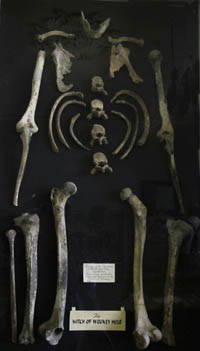
Skeleton of the Witch of the Wookey Hole as displayed in the Wells & Mendip Museum, Wells, Somerset, United Kingdom.
In addition to the legend, the skeleton, and the stalagmite there are also marks in the Wookey Hole and other Somerset caves that show they have been associated with Witchcraft during more recent times. Protection from witchcraft was an important consideration from 1400 to as recently as the early 20th century. Charms or protective wards were used to protect buildings from evil, spirits, or witches. These included burying “witch bottles” containing bent pins and urine underneath doorways, making protective marks (“masons marks”) as the building was built, as well as walling up various things (including cats) during construction [6]. The general idea is that evil powers could not pass a threshold protected by bent pins, or magical markings. This is similar to the folk/literary idea that vampires must be invited in or else they cannot cross a threshold. The marks took a variety of forms, ranging from plain circles, to crosses, arrows, or a mark with six petals within a circle [7]. Often the marks are on or near lintels, or near chimneys. In many cases these marks and burials are the best documentary evidence we have about true folk beliefs in witchcraft and magic, as any written documentation was likely to be filtered through the viewpoint of whoever was writing it down (be they magician or witch-hunter).
Protective marks against witchcraft have been found throughout caves in the Somerset region, including the Wookey Hole [8]. Of particular interest in terms of the cave markings is the use of letters such as M or W designed to invoke the Virgin Mary thought the use of her monogram. The W formed through two intersecting V’s represents the name of Mary, Virgin of Virgins (Virgo Virginum) [9]. Coincidentally the V’s also represent bent pins, but that’s just my non-professional observation.
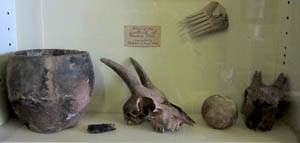
Artifacts found with the Witch of the Wookey Hole skeleton. Comb, milking bowl, two goat skeletons, a billhook, and the alabaster ball. As displayed in the Wells & Mendip Museum, Wells, Somerset, United Kingdom.
In both Wookey Hole as well as several other caves in the area the conjoined V marks have been found. These marks were most likely made during the 16th and 17th centuries [10]. The number of these marks, and their locations near natural chimney (“the Witch’s Chimney” feature) or cold areas in the caverns, suggest they were placed there for protective reasons. It is also believed that the idea of the stalagmite in Wookey hole representing a witch arose during the mid 16th to mid 17th centuries [11]. The legend appears at about the same time the protective marks start appearing, which also coincides with the peak of the witch trial period around 1600. This legend was reinforced in writings throughout the 18th and 19th centuries, and was essentially set in local folklore and writings by the middle of the 18th century.
So what does all this mean? I believe that this story illustrates the complex historical, folk, and archeological narrative that Pagans must understand in order to understand our religion and its context. Layers of Saxon Pagan, Roman, Christian, and modern artifacts and interpretation go into making up the “truth” about the relationship between caves, witchcraft, and magic in this story.
To start at the very beginning we have the skeleton and its associated artifacts. There are two key parts to the story of the skeleton: its association with Saxon or Romano-British culture, which may have been Pagan, and the alabaster sphere. In particular the sphere is made of stone that is not local to the area, and is of a size that it would not have a lot of practical use (too small for a throwing bolo or similar and too expensive and shaped for use as a club).
The Anglo-Saxons believed in witchcraft before they were Christianized [12a]. In fact the Anglo-Saxon word for “witch” is “wiccan.” In fact the Old English wicce and wicca are often associated with the Latin words for diviner or soothsayer, which, given their emphasis on the wyrd and fate may have been an important function for the Anglo-Saxon witch [12]. This may, and I emphasize this is simply speculation, have been somehow associated with the alabaster sphere, as spheres today are used in scrying. In reality, however, we know very little about Anglo-Saxon religion or religious practices [13].
The idea of an older person, perhaps a woman, living in the cave, tending goats and practicing magic is a plausible explanation for the single skeleton and the materials found with it. If that was the case the legend of the resident of the cave might have persisted into early modern times, and fueled the association between the cave (or caves) and witchcraft. That also implies that the skeleton and artifacts represent one of the first “wiccans” we have on record, including the artifacts they used in their craft.
The next association of the cave with witchcraft comes in the mention of the stalagmite as a witch’s profile in 1628. The legend grew over the next century with the idea that the stalagmite represented a witch firmly emplaced in literature by the mid 1700s. It was most likely at this time or immediately before that the idea of a battle between the witch and a monk took hold, with the monk getting the upper hand and turning the witch to stone. This all was coincident with the winding down of the witch trials, and the time when witchcraft and spell-making were taken seriously in England.
This was also most likely the time period when visitors to the caves began scribing protective marks. Since these marks occur in many different caves in the region, it is unlikely they were specifically directed just at the legend of the witch at the Wookey cave. Rather caves may have been seen as magical places in themselves, portals into the underground world from which mischief could issue. These marks are inherently Christian in nature, and the people making them were most likely protecting themselves from threats they saw in a Christian context, including witchcraft. Pagan concepts by this time had been subsumed into a Christian mythology, if they had ever been carried over in the first place.
Finally we come to more modern times with the idea of the classical witch of folklore that has been “defanged” by the enlightenment. Looking at the advertisement on today’s Wookey Hole attraction you can see the cute, pointed hat, Sabrina-like witch that has come to be the folk interpretation of “witch” in popular culture. This modern layer also includes our neo-Pagan interpretations, with the viewpoint of religious revivalists or deconstructionists, seeking to understand a poorly documented and distant past. We also project our modern concept of magic, witchcraft, and Paganism onto the past, and attempt to fit it into our concept of how things might work.
To me these layers are an amazing summary, in one location with a few artifacts, of the journey that Paganism has taken over the years. Rising from the lone worker in the cave, through the persecution and fear of the early modern period, and into the modern era of academia, folklore, and revivalism. Any claim about our religion is more complicated than we understand and is made obscure by layers of meaning, interpretation, and confusion that have been laid down over centuries. In this sense we are truly on our own as we construct a modern version of Paganism. There is no definitive text, or ancestors, we can look back on for a clear historical thread that ties us to them. There is scholarship, and the ability to reconstruct, but to truly know, to be a part of them, is almost impossible because of the cultural distance that stands between us an them.
[1] For one, rather hyperbolic, retelling of the story go here: http://www.wookey.co.uk/witch.htm [warning: a crappy sound file will play when you go].
[2] The whole mess can be examined here: http://www.wookey.co.uk/ [now the crappy sound will be associated with a video advertisement…the taste level here is not high as Tim Gunn would say.]
[3] http://www.kevwitch.co.uk/ I have absolutely nothing to say.
[4] http://www.wellsmuseum.org.uk/index.html
[4a] Jim Hanwell, et al. Wookey Hole: 75 Years of Cave Diving and Exploration,
[5] The artifacts include a comb, a “milking bowl,” a billhook, two goat skeletons and the alabaster ball. Both the artifacts and the skeleton are currently in a tug-of-war match between the owner of the cave/circus and the museum, http://www.show.me.uk/site/news/STO283.html.
[6] For a great summary of the archeology of magic see: Ralph Merrifield. The Archeology of Ritual and Magic, New Amsterdam, 1987.
[7] C.J. Binding and L.J. Wilson. “Ritual Protection Marks in Wookey Hole and Long Hole, Somerset,” Proceedings University of Bristol Speleological Society, May 2010 pp. 46 – 72. C.J. Binding and L.J. Wilson. “Ritual Protection Marks in Goatchurch Cavern, Brurrington Combe, North Somerset,” with an appendix on “The Use of Conjoined Vs to Protect a Dwelling,” by T. Easton, Proceedings University of Bristol Speleological Society, 23(2), 2004, pp. 119 – 133.
[8] Binding and Wilson, 2004 and Merrifield 1987.
[9] Easton in Binding and Wilson, 2004.
[10] Though there is no accurate way of dating the cave markings. Binding and Wilson, 2004, 2010.
[11] The earliest reference to the stalagmite in 1470 simply refers to it as a “figure of a woman” with the first account of the actual witch occurring in 1628 in the accounts of a lawyer who visited the cave and saw the formation known as the “Witch of Ochies Hole.” Binding and Wilson, 2010.
[12a] http://en.wikipedia.org/wiki/Anglo-Saxon_paganism#cite_note-Hostile_Witnesses-43 and Thor Ewing. Gods and Worshippers in the Viking and Germanic World, Tempus, 2008.
[12] http://en.wikipedia.org/wiki/Witch_%28etymology%29
[13] Ronald Hutton. The Pagan Religions of the Ancient British Isles: Their Nature and Legacy, Blackwell, 1993.