Myths and Legends:Journeys Through Time
Every year the Earth goes through a series of changes. Where the change begins isn’t rightly
known but the beginning is assumed to be Spring; a season of rebirth and new beginnings.
Spring is the time when the world wakes up from it’s winter induced slumber and takes on
a new look. The tree leaves and flower buds peek at the world around them and decide
to be a part of it. The newborn animals begin to learn how to survive and become adults.
After spring comes Summer; a season of growth and destruction, of good times and on
occasion bad times. Summer is a time of temperment, sometimes Mother Nature’s temper
is good, at times it’s bad. Following summer comes Fall; a season of change and preparation.
Fall signifies the time when Earth starts to feel old and sleepy. The crops are harvested, the
animals know what to do for their first winter and the plants begin to slowly fall asleep. Fall
is almost a time of sadness. Winter is the final season to appear and it’s the most harsh. The
air is bitingly cold and so very dry, the snow piles up, the ice is slippery and dangerous.
Winter although beautiful can be deadly as most beautiful things often are. It’s ok though
because after winter comes Spring and the cycle begins again. The reason for the seasons
is quite simple. In Greek and Roman mythology, the world becomes sleepy, then desolate
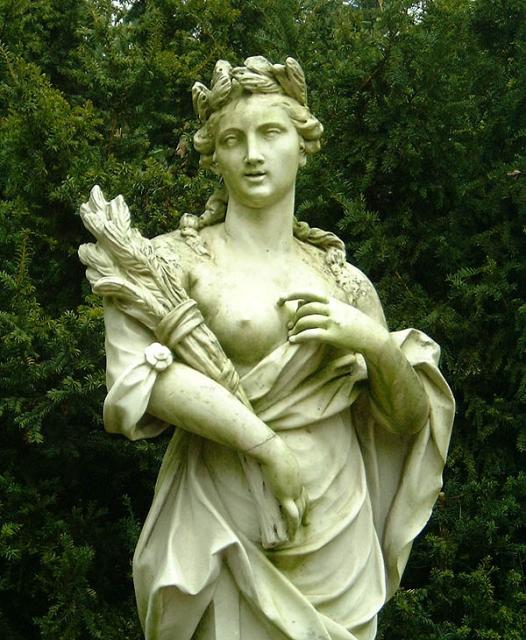
and barren for four or more months because of the goddess Demeter. Demeter (known as
Ceres in Roman mythology) is the goddess of agriculture, nuturing, fertility, and grains.
This was important to the Ancient Greeks and Romans because it was the grains and
knowledge of agriculture that enabled them to live. The agriculture provided them
with the knowledge of how to farm grain which provided them with the means to make
bread which they would eat. Fertility too is important because if the land was fertile, it
provided a good crop and abundant harvest. If man and women too were fertile, then they
were able to have children and help the population grown. Demeter’s most known role in
mythology is that of Persephone’s mother. Persephone is the maiden who is kidnapped by
Hades, the God of the Underworld and made his queen. He abducted her because he thought
she was beautiful and fell in love with her. Zeus allowed the abduction and poor Demeter
had no clue of what happened to her child. She spent months looking for her child, thus
neglecting her duties. While she was looking for Persephone, several things happened to
her. She was taken against her will by Posiden in the form of mare and stallion, she became
unhappy and took the guise of an old mortal woman in the city of Eleusis, she became a
nursemaid after a long depressed state, and decided to make a future king immortal.
All of this came about because when Persephone went missing, Demeter searched
everywhere for her. At one point during her travels, Poseidon noticed her and began
lusting after her. She tried to hide from him by disguising herself a mare. Poseidon
was not fooled and became a stallion. The trip to Eleusis happened because she was
informed by Hecate that Zeus; Demeter’s former lover (before Hera) was the one who
allowed Hades to kidnap and marry Persephone. Feeling betrayed Demeter renounced her
divine duties and went into hiding. Due to her renouncing her divine duties, the world
started to become barren and all harvests ceased. It became a never ending winter.
Zeus finally realized what he had done and sent messangers to apologize and coax Demeter
into coming back and resuming her duties. She agreed to only do so if Persephone was
rescued. Zeus agreed and ordered Hades to release her. Hades, being unwilling to give up his
bride persuaded her to eat a pomegrante. Knowing that those who ate anything in the under-
world were not allowed to return to the Earth, Persephone having refused all food until now
because of this, accepted the pomegrante and ate the seeds. Having done this, she was
forever bound to the Underworld, one month for every seed she ate. Some versions say she
ate four seeds, others say six even seven. Demeter wasn’t happy that Persephone had eaten
the seeds but she was overjoyed at having her daughter back even if only for six months or
so. Demeter’s happiness at having Persephone back gives us spring and summer. Her sadness
and sorrow at Persephone going back to the underworld, gives us fall and winter. Spring
signifies Persephone’s return, Summer; her stay with her mother, Fall; the time when
Persephone leaves her mother and Winter; the time Demeter is without Persephone.
Despite everything Demeter has been through she had never acted upon her divine right to
become vindictive toward anyone who didn’t honor them in a dignified fashion. She was too
kind hearted to do so and even when she indulged in it, she always made it right. She’s a
symbol of strength, change, fertility, love, nurturing and the ability to be all of this even
when faced with despair. Of all the gods and goddess, Demeter is perhaps one of the
strongest, maybe not in power but in her ability to continue loving and nurtre people
no matter what is going on and how bad things get.
http://www.theoi.com/Olympios/Demeter.html
http://www.goddessgift.com/goddess-myths/greek_goddess_demeter.htm
http://www.goddessgift.com/goddess-myths/goddess_demeter.htm