The Mugwort Chronicles
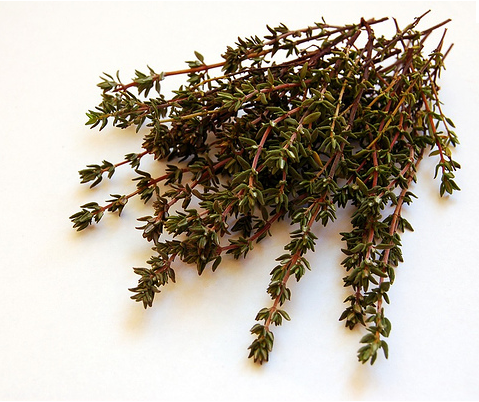
Just in Time for Cold Weather Coughs: Thyme
Over the years Thymus vulgaris (common Thyme) has become one of my most esteemed herbal allies, not only for the lovely aromatic flavor it imparts to my favorite dishes, but for its healing properties, as well.
A member of the lamiacae or mint family, Thyme is a valuable addition to the herbalist’s medicinary as we approach the winter months for its soothing effects for many respiratory conditions. Its antispasmodic, expectorant and antimicrobial properties help to quiet coughs accompanying colds and flu. It is carminative and helps to ease digestive upsets. Thyme’s antibacterial and antimicrobial properties make it a good choice for treating urinary tract infections as well as for topical use to help heal wounds. And have I mentioned that it tastes wonderful when sprinkled in an omelet, on vegetables, or in soups?
Thyme is often found in the traditional bouquet garni-an herbal bundle used to flavor stocks or stews usually made with three sprigs of Parsley, two sprigs of Thyme and one Bay Leaf. Other herbs such as Rosemary or Tarragon are sometimes added depending on the region or the cook’s preference. The herbs are tied together with string, added at the beginning of the simmering process and removed before serving.
This past summer I planted Thyme in a large pot in the garden along with Basil and Dill where it seemed to grow quite contentedly. Intrigued by a friend’s experiments with herb-infused honeys, I decided to try making an infused honey using Thyme. The combination of the two ingredients sounded like a wonderful soothing remedy for scratchy throats and coughs.
I am fortunate to have a great local resource for raw honey. As this was a bit of an ‘experiment’, I used only ¾ cup of honey and approximately ½ to ¾ cup fresh Thyme- leaves, flowers and stems. I washed the Thyme carefully with cool water, allowing it to dry overnight on a wire rack covered with two layers of paper towels. The next day, I add the Thyme to the honey, thoroughly stirring it to make sure the herb was completely coated. In retrospect, the next time I make this I will chop up the Thyme. For my experiment, I used the aerial parts uncut as I was concerned that the finished product would be too intensely flavored (it wasn’t).
I then placed the jar containing the honey and Thyme in my trusty Little Dipper filled with water. The Little Dipper, made by Crock Pot, was a wonderful thrift store find for which I have found multiple uses. It holds 2 cups of liquid and heats to approximately 110 degrees Fahrenheit.
After heating the honey in the water bath for several hours, I removed the jar, covering the top with a piece of paper coffee filter cut to size and held in place with a rubber band. Leaving off the lid but covering the jar with the paper coffee filter allowed any moisture to escape while preventing contaminants from getting it (several layers of cheesecloth would also work).
I placed the jar in a dark cupboard for one week, checking it daily for any signs of moisture. After several days I noticed a thin layer of ‘foam’ on the top of the honey which I carefully removed with a very clean spoon. When the week was up, I removed the paper coffee filter and again placed the jar into a water bath in my Little Dipper for several more hours. After allowing the honey to cool, I strained it through several layers of cheesecloth-ugh…a very messy process-into a clean glass jar with a lid, labeling the jar with the date and contents. The final product: a delightfully flavored honey.
I have since tried it for a scratchy throat as well as a dry, irritated cough-a teaspoonful, as needed (adult dosage), and it worked quite well for both problems. While this is a relatively safe remedy, please remember NEVER give honey products to babies under the age of 12 months due to a rare but potentially fatal condition called infant botulism, which can occur when spores of the bacterium Clostridium botulinum, sometimes found in honey, germinate in a baby’s immature digestive system.
Sometimes the most effective herbal remedies are already in our pantry just waiting to be discovered.
This information is offered for educational purposes and is not intended to take the place of personalized medical care from a trained healthcare professional. The reader assumes all risk when utilizing the above information.
Copyright© 2012 Louise Harmon
All Rights Reserved
References:
Wikipedia. Bouquet Garni. Retrieved from
http://en.wikipedia.org/wiki/Bouquet_garni
Accessed 11/11/2012