Book Review: Tarot of the Magicians by Oswald Wirth
Tarot of the Magicians
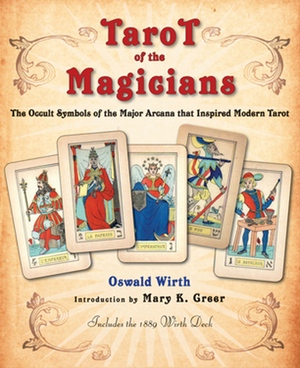
by Oswald Wirth, with an introduction by Mary K. Greer,
published by Red Wheel/Weiser LLC, California,
soft cover, 228 pages plus 8 pages containing a full-color pull-out reproduction of Wirth’s 1889 tarot deck
Tarot of the Magicians was written by Oswald Wirth and originally published in 1927 in Paris, when it was called “Tarot of the Medieval Image-Makers.” The first English translation was published in 1985. The book is divided into four sections, each rich with information about the cards, their history and their use in divination. It says a lot to me that the descriptions by Wirth of the 22 Major Arcana cards (Wirth’s deck consists of only the 22 Keys or Majors) are found in the second section of the book and not the first. Before speaking of the symbolism found in his individual cards, Wirth treats us to some fascinating discussions regarding the Tarot and its correspondences to the Kabbala, astrology and the constellations, the planets, colors and shapes, the elements and the Hebrew alphabet. Wirth speaks of groups and pairs, couples and comparisons, all used in a meaningful way to perceive patterns and connections that offer depth and texture to card interpretations.
Even within his individual card descriptions, Wirth tells of patterns and connections, along with an in-depth discussion of his understanding of the symbolism to be found in each card. He speaks of alchemy and the elements, Gods and Goddesses, colors and numbers, and he presents mysteries and possibilities that make me want to ponder and think. The Divinatory Interpretations presented at the end of these fascinating card descriptions include useful keywords and archetypal correspondences that tie together the card descriptions that precede them.
The third section tells the “story of the Major Arcana” in multiple ways, offering possible inspirations for the 22 Keys such as a description of where we’ve come from and where we are now and where we’re going, a program that will bring initiation, a manifestation of good or bad, or a method for comprehending and experiencing the philosophies of Hermeticism or Freemasonry. The fourth section talks of the art of divination as it connects to the Tarot, and the application of both imagination and interpretation in the divination process. The Appendix offers more descriptions of images and the sources of their symbolism. The cards included at the end of the book are a wonderful bonus; being able to look at the cards as we read Wirth’s explanations of the symbolism used in their creation is like icing on an already flavorful cake.
In learning about the Tarot and in creating a working foundation that allows us to work with the cards, Wirth felt it was necessary to create “. . . a perfect unity of symbolism, so that everything fits into the 22 compositions, which must throw light upon each other and must contain no arbitrary detail which is not justified.” Wirth has succeeded in doing this in Tarot of the Magicians, and he brings us to the next level of understanding of the Tarot in this book. Much more than a keyword list, this is a must-read for those new to the Tarot as well as for seasoned Tarot enthusiasts.