Thriftcrafting: Witching on a Budget
Altar alternatives
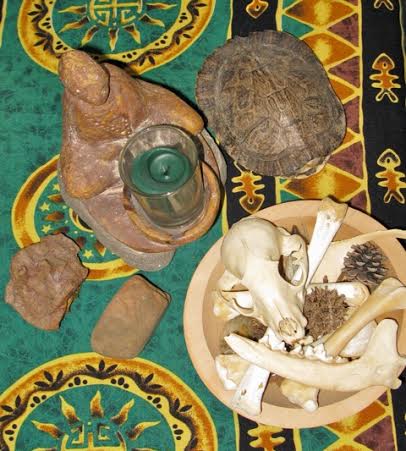
Merry Meet.
This month’s column is about how to set up an altar without setting you back financially.
Some of the items typically found on an altar are a covering, one or more candles in holders of some sort, salt, water, incense and something to burn it in, a libation dish or bowl, items that represent the elements, and something representing one or more deities.
Nothing need come from a witch store, although I do advocate patronizing the ones near you when you do buy – rather than online sources – whenever possible. Pagan festivals and their vendors are also worthy of your support. When we can afford it, buying their wares will help ensure their survival.
Before we get into altar coverings, know that there are no requirements that your altar be covered and nothing says you can’t paint or carve symbols on your altar instead. If you chose to cover it, there are many beautiful ones to be had. The ones I have come from thrift stores and tag sales and from the fabric store where yards of on-sale fabric was cut off the bolt. Sheets, scarves, curtains and quilts have all been used as altar covers. I was gifted a sarong that I use both as a wrap and an altar cloth. I have also collected several tablecloths of different sizes, shapes and colors that drape my altars.
I say altars, because I have one for each direction. They are up at all times because I have been blessed to have so much space in such a small condo to use for magic. East is my main altar. It’s made up of a weathered plank washed up from the ocean, supported by a wooden box and one of the shelves of a bookcase.
A small round table sits between two chairs in south, and on it is my fire altar. West is the round table next to the couch. It holds a lamp plus items which speak to me of water. North is the entire coffee table in front of the couch when I’m doing ritual and half when I must press it into mundane service. When hosting a circle for a moon or a sabbat, the coffee table moves to become the center altar and is dressed just for that occasion.
If it’s meaningful to you, and evokes a sense of reverence, it has a place on your altar.
Whether you use energy candles, directional candles, intention candles or deity candles, they need holders. Mine were gifted to me or picked up used along the way. Jars, vases, buckets of sand, wood pieces with holes drilled in one end, bottles, decanters, carafes and shot glasses also make useful candle holders. One day I hope to make some out of modeling clay that exactly fit the various small intention candles I burn.
While it’s wonderful to be able to afford beeswax or soy candles, the ones from the dollar store work just as well, given the same intent and energy.
Salt can be kept in a vintage salt cellar or bowl with its tiny spoon, a jar lid, a pretty tin or a small jar or. A little vintage glass restaurant creamer bottle with special meaning holds mine.
Water can be held in a glass – plain or fancy, a bottle, decanter, carafe or a jar. Use what you have.
Stick incense is by far the cheapest way to create some smoke for smudging and introducing the elements of fire and air. I have come to like the charcoal disks because then I can burn almost anything I mix together, as well as resin incense. I don’t have a formal censor, so I put sand in the bottom of a cauldron, goblet or other container that can withstand heat and put the lit charcoal on that. The same sand in the same container can hold incense sticks, as can a salt shaker set on a plate.
Again, a libation dish or bowl can be anything that will accept your offerings. I am always on the lookout for hand-thrown pottery.
When I have consecrated and blessed an otherwise mundane object for use in ritual, I tend to continue its use only in ritual.
While the use of salt and water, and the burning of incense represent the four elements, I like to add objects for each of them as well. These are generally natural objects, but can also be other found items or even tarot cards.
Some pagans have likenesses of the God and Goddess on their altars. While there are many beautiful statues for sale, there are also many alternatives that can be just as meaningful. The twig Goddesses and Gods I wrote about last month in Witchcrafting, for instance. I was given a small mermaid that sits on my west altar, while in south is a ring of five naked women dancing that was found at a yard sale. The only Goddess for which I paid full price came from a craft fair. A primitive figure of fibers and natural items, she is my Earth Mother. Other small Goddesses have found their way onto my altar – primarily finds and gifts.
The God is represented by a green plastic barbarian warrior that must be 40 years old, given to me by the witch with whom I started my path. It had served as both Green Man and a spiritual warrior on his altar, and so it has for me as well. Other symbols, such as horns, have also held the God energy.
Framed images of deities work well, and many people use gold and silver candles for the God and Goddess.
Whatever you do, know that all altars are beautiful for they reflect those who made and gather before it.
For additional ideas, check out my boards on Pinterest.
Next month, we’ll talk about tools on the altar.
Merry part. And merry meet again.