Spellcrafting: Spells and Rituals
‘The season of limits.’
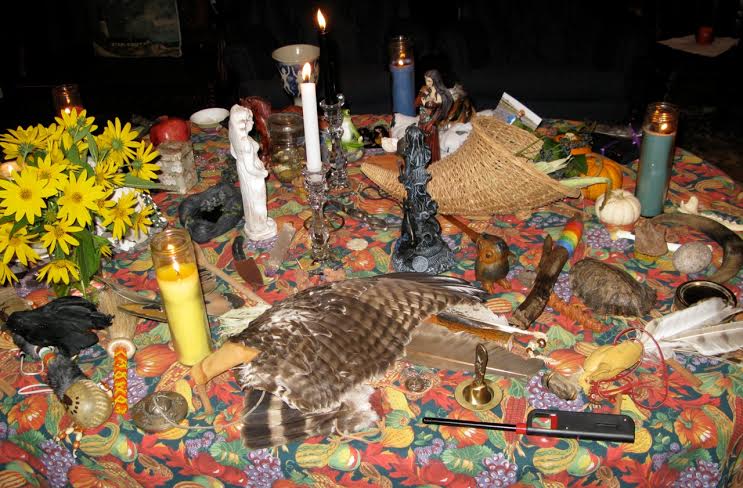
Merry Meet.
There is a poem that has been part of my Mabon ritual since I came across it about six years ago. It touched me deeply, and has come to be even more meaningful as I move into the autumn of my life. At 60, I am claiming the title of crone this Mabon, and I find that Patricia Monaghan’s words apply to the circle of my life as well to the wheel of the year.
I share them with you in the hopes you’ll find a phrase or more that speaks to you as the seasons change and you celebrate the coming of the dark at Mabon.
Merry part.
And merry meet again.
Fall
from Part Three: The Measure of Her Powers
of “Seasons of the Witch”
by Patricia Monaghan
Now comes the time of reckoning, the season of limits.
There will never be more than there is now. The harvest is done, the cellars are full. Two seasons of growth have lead to this richness, this security, this abundance. This is the time to celebrate the plenty that work and time have wrought. Now, the time to feast with friends, share the bounty, toast the work well done.
Now is the time, as well, of endings. For nothing more is growing. Nothing more will grow this year. There will never be more than there is now. The winds of autumn descend to tear seed from stalk, to scatter what has not been captured.
This is the time to decide what will die. Not all of last spring’s calves and lambs and ducklings can be fed through the winter. Some will die, and in dying provide food. It is a season of decisions. And of prophecies: for as other life dies, it foreshadows our own deaths. The taste of death is in the air in fall. On our tongues, too, the taste of death: of plants that give us their seeds, of animals that give us their flesh.
Such communion! As we pick the pumpkin from its frozen shriveled stalk, as we press the juice from apple’s flesh, as we tear out carrot life by its roots, we taste the deepest knowledge: that we need others to survive. That we breathe only because something has died. That we make our own flesh of the flesh of our world.
Never in the seasons of our life do we feel more responsible.
As she moves through autumn, a woman feels a passionate connection with all life. Yet, wise in the seasons of living, she can be unsentimental, even pitiless. She does not try to nurture everything and everyone, for she knows not all can – should – survive. She becomes selective. There is enough of everything – strength, love, passion, lust – everything but time.
Time, she knows, grows short. Nothing seems endless anymore. her life grows full of endings: parents and friends die, animals she has loved disappear in a gasp, dreams fade beyond reclaiming. She does not recognize, when the deaths start, that fall has begun. But later, she will remember: After that one, it was never the same. Never again can she hold a living body without knowing the fragility of it’s life, the closeness of its death.
She finds that she has limits. Her energy falters, her mind drifts, her patience snaps. She begins to husband herself, to save herself for what really matters. She has seen enough to guess the trajectory of most events, to hold herself back from repeating old mistakes. She knows now that some energy is wasted. So sometimes she seems parsimonious, unwilling to expend in waste. But other times she is generous. That old coat? Give it away. That pretty pin? Oh, do take it. The half-finished book? No, it’s yours. She does not need to cling to what she has outlasted. Things leave her: she does not need it all.
Fall consumes a woman many times before and after middle life, whenever the time demands that she becomes decisive. She empties her womb of a conception; she leaves a convent, a marriage, a career; she puts a loved old pet to sleep. She cleans a closet, she gives away old books, cuts off her hair. Autumn moods find her free and vibrant, impatient of delusions, ready to do whatever she needs to do.
For she knows what she needs, and she wants it fiercely. For every false dream that dies, a true one is remembered. She climbs mountains to stand in alpenglow, she gallops out on a magnificent horse, she paints her secrets and her nightmares. She bears a last and cherished child; she remembers passion with an old friend; she writes her own, her individual, story. She knows what memories she needs to store, to provide her winter years.
The autumn woman moves towards dreamtime. Though she knows her limits, she has also felt limitless. She has known the ineffable. She wakes at night from dreams of high windy places where small blue flowers bloom, and she knows in her bones that such places exist. Luminous beings appear in her dreams and pull her towards them. She recognizes the dust of infinity in a windstorm, the odor of timelessness in a fire.
There is a transcendent energy about her, but she remains rooted in life’s imminent realities. In her eyes you see the fire of primal knowledge: the knowledge of life and death. She knows that she will not escape this life alive. And so she embraces it, moment by moment by moment.