Goddesses of Sorcery
Baba Yaga

There are many stories of Baba Yaga but most likely her story is very old and comes from the stories of the old Gods long before our modern times. She is a Crone Goddess who is honoured at Harvest and she is present in the last sheaf of grain where she ensures that the grain will grow again. Later on she became, like most Witches in Europe, a scary story to frighten children.
The first clear reference to Baba Yaga (Iaga baba) occurs in 1755; Mikhail V. Lomonosov’s Rossiiskaia grammatika (‘Russian grammar’). In this work Lomonosov lists Slavic gods and their Roman equivalences but Baba Yaga has no Roman equivalent showing her unique status.
In some tales a trio of Baba Yagas appear as three sisters, all sharing the same name. For example, in a version of “The Maiden Tsar” collected in the 19th century by Alexander Afanasyev, Ivan, a handsome merchant’s son, makes his way to the home of one of three Baba Yagas because he is searching for the ‘thrice tenth kingdom”. She sends him on to her other sisters and at the last Baba Yaga he blows three magickal horns (obtained from the second Baba Yaga) which summons the firebird that carries him further on his magical quest and protects him from death. From this reference it’s possible that she was also seen as a triple Goddess.
Baba Yaga can fly but she does not use a broomstick. Instead, she sits in a giant mortar (a bowl for grinding food) with her knees almost touching her chin. She drives very fast across or above the forest floor, and uses the pestle (the grinder) as a rudder held in her right hand. She sweeps away her tracks with a broom made out of silver birch held in her left hand. Wherever she appears, a wild wind begins to blow, the trees groan and leaves whirl through the air.
Her home is a hut deep in a birch forest, in a place that is difficult to find, unless a magic thread, feather or doll shows the way. The hut has a life of its own. It stands on large chicken legs and can move about. Its windows act as eyes and the lock is full of teeth. A post fence surrounds the hut. The posts are made of human bones and topped with skulls whose blazing eye sockets light up the forest. Very often the hut is guarded by hungry dogs, evil geese, swans or a black cat.
The hut can spin around and moves through the forest. It makes blood-curdling screeches. Most of those who go in never leave, as Baba Yaga washes them, feeds them and then sits them on a giant spatula, before putting them in her oven. In many stories, the fate of those entering her hut is in their own hands. A guest may, or may not, fit into the oven, depending on how they sit on the spatula.
From this story we see that she is connected to the Birch tree. This tree is also the tree of Brighid and the traditional wood that Witches used for their brooms because it is said to sweep away not only physical dirt but also cleanse on the astral level. So Baba Yaga flying with her Birch broom whisks away negativity and brings light and healing. Her fence is made of human bones and skulls which connects her to Goddesses helping with the passage of souls to the otherworld after death. She can carry souls in her mortar to the other side.
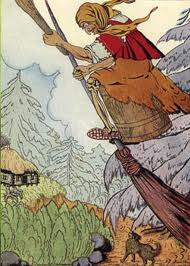
The dogs, geese, swans and the black cat are her animals. They protect her and help her in her work. If you want to approach her to ask for abundance or help surrounding death issues you can ask for the assistance of one of these animals. Bring cookies! In the stories from Russia the children gave the dogs, geese and swans cookies and the cat slices of ham. They also tied ribbons on the birch tree to ask for help. In the story they were asking help to flee from Baba Yaga but if you approach her with love and respect they will help you find her in her secret house in the birch forest.
The reason why many people go in and never leave is because she takes their souls to the Otherworld as it is their time to die, not that she murders and eats people! To contact her try placing on the altar a doll tied up with a red thread and a black feather, an image of a black cat, a plate of cookies and some bunches of wheat or corn. You could also place a mortar and pestle as well and a little chicken statue. Have fun with the altar and remember that the Old Woman of Autumn, Baba Yaga, can be an ally and friend like a grandmother. Make sure you are very polite though, as she doesn’t like arrogant or rude people. Sit in meditation before your altar and ask for her friendship and help. Don’t forget the cookies!
References
http://myths.e2bn.org/mythsandlegends/origins117-baba-yaga-and-vasilisa-the-fair.html
Guterman, Norbert (trans.) Russian Fairy Tales. Pantheon Books. 1973 [1945].
Johns, Andreas (1998). “Baba Yaga and the Russian Mother”. The Slavic and East European Journal (American Association of Teachers of Slavic and East European Languages) 42 (1).
Johns, Andreas (2004). Baba Yaga: The Ambiguous Mother and Witch of the Russian Folktale. Peter Lang. ISBN 0-8204-6769-3.
Monaghan, Patricia. 1990. The Book of Goddesses and Heronies. Llewellyn Publications, St. Paul, Minnesota.
Telesco, Patricia. “365 Goddess: a daily guide to the magic and inspiration of the goddess”.