Following Threads of Life in Chaos: The Tao for the Modern Occultist and Pagan
Whew! I haven’t written a creative piece in quite some time; life really hit me with a curveball, and I had to a take an unexpected leave of absence from pretty much everything here, spare the occasional book review. I’m happy to say that while the things that caused my absence aren’t completely resolved, I am at a point where things have slowed down enough for me to write this piece, which I’ve been wanting to write for a little while now.
My spiritual seeking started in high school. Until late in my sophomore year, so about 2010, I found that science, like I previously thought, couldn’t account for everything we experience in this life. I was a hardline Atheist for years, having rejected the christian religion I was born into for a multitude of reasons. I had been practicing Martial Arts for some time, and was introduced to practices such as Kung Fu, which then led me to discover Shaolin Buddhism, which incorporates both physical movement and martial arts with buddhist ideas. Largely, Shaolin is taught master-to-student in monasteries, but studying it, along with Samurai lore and beliefs, led me to researching buddhism, which in turn led to me discovering Taoism. Taoism was my first taste of a polytheistic, animistic, nature-based religion. I immediately resonated with the Yin-Yang, having it adorned on my martial arts uniforms as part of my federation patch for years now.
Eventually, I left martial arts in pursuit of spiritual truth, and inner peace. Taoism in large part led me to believing in the idea of a single force, or energy, connecting everyone and everything. The girl I was dating at the time, my High School Sweetheart, was a closet Wiccan, and that summer she introduced me to things like the Tarot, Oracles, Runes, and eventually spells. That summer is what turned me Pagan; but up until then, I would probably have identified as a Taoist. I would meditate daily, sometimes multiple times a day, with incense lit and the whole 9 yards. I felt connected, both to myself and the world around me. For the first time, I felt inner peace, realizing that as was within, so was without. I give Taoism and its philosophy a lot of credit in shaping my beliefs all these years later. Taoism isn’t a religion in the sense that we Americans usually think of; there are books with wisdom pertaining to the Tao, yes, but they aren’t like the Bible, or Koran, or any other holy book we may think of. They instead show the reader the way, that is, the Tao. The Tao can be translated to mean “the Way”, that is, the natural way, or order of the universe and of nature.
Many years later, I came across this idea of a “life force” in the form of the Awen while studying and practicing Druidry. The similarities between the two, in terms of interpretation, connection, and overall conception were too blatant to ignore for me, even though they come from two very different cultures. I’m not saying that the Awen is only comparable to the Chi as Taoists would call it, because the Awen does contain an inspirative element in Druidic tradition, where as Chi can incite this, but it is only through the energy itself, instead of a cause of it. Animistic concepts can be convoluted due to culture differences and language, not least of all, time, which works against most anything, that is to say, that the initial conception of these two forces may have been different then, than they are today. So, without making the waters any more murky, let’s take a deeper look at some of the core principles of Taoism, and how we, as Pagans, Magickal, Spiritual and Mystical folks can integrate Taoism into our everyday lives.
Chaos and Order, Yin and Yang
Recently, my life hit a point of utter chaos, disorder and rapid change. My grandfather passed away in May after a 4 year long battle with cancer. He was more of a father figure to me, due to my father being abusive; the loss was harder than any other I’ve experienced because of how close we were. On top of that, I have also been working through some very complex mental health issues that have consumed a lot of time (and energy), and I’m still not fully back at normal energy levels. Between new diagnoses in that area of my life, as well as physical health ailments and the grief associated with loss, I found myself feeling lost, disoriented and generally apathetic to anything spiritual, at a time when I needed it most.
A lot of things in my life occur spontaneously, or on a hunch/intuition. This is a core principle of the Tao-living in tune with the ebb and flow of nature, the natural way of the universe, and finding my way back to Taoism some 15+ years after I had initially discovered it, was no coincidence, but in my opinion, divinely guided. The roots of my tree needed water, and that water could only come from the Tao.
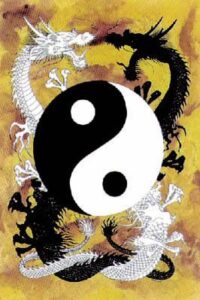
Another core principle of Taoism is the Yin and Yang, which when together, encompass the entirety of creation. Within the Yin, there is Yang, and within the Yang, Yin. All is interconnected and flows into a whole, with the true path, or Tao, being somewhere in the middle, or grey. Embracing qualities of both light and dark, masculine and feminine, day and night, is the way to find our personal center, and the center of the universe. Taoism looks for divinity within, and without, much as Paganism does. Wu Wei, which conveys action through inaction, ties directly into the Yin/Yang concept; it is only through inaction, rather than forceful intervention, can we live our lives in accordance with the Tao.
Passive Submission, or Peaceful Enlightenment?
Taoism’s critics often cite this religion as being one of passive submission, or in other words, letting things happen to you. This isn’t the case; if we study other ancient Eastern philosophical tracts, specifically from China, such as Sun Tzu’s The Art of War, then we can see that decisive action is indeed called for in certain circumstances, and in a personal sense, we must act in at least small ways to survive day-to-day. The Art of War is as much a military treatise as it is a monologue based in Taoist and (to a lesser extent) Confucianist rhetoric. The Tao is even mentioned by name in it!
So, if Taoism’s focus isn’t literally on passive submission, then what is it? I like to call Taoism a system of peaceful enlightenment; many who experience enlightenment will also experience with it a shocking series of events, usually their tightly held world-views crumble, and it feels as if life itself is ending. Taoism, through its receptive nature, allows one to slow down, and find their center again, which is where the truest of truths come from. Enlightenment, awakening, can be peaceful, even uplifting, if we allow ourselves to grow.
“Growth comes with shock” is an old Taoist adage, and while true, we must also accept that the old must be swept away to make way for the new. Following the above adage, I’ll follow it up with one of my own that I’ve come to find true: “After the shock of growth, comes the nourishing rain and warm sun”. Imagine the shock of growth transferring from your heart and mind to a leaf, and allowing that leaf to float on down a river or stream; you can feel it, but do not stew in it. Once the shoots have gone above the soil, the new normal is established, and the plant will flourish. It does not need external validation or outside energies to fulfill its destiny; it simply does.
Where am I going with all this? Well, Taoism is an excellent philosophy to embody as a spiritual, magickal, person; it most definitely fits in well with Pagan beliefs, animistic beliefs, and because of its nature-centered views, can be integrated alongside many different spiritual belief systems. I seem to recall seeing on social media once, a Catholic Priest saying something to the effect of “Buddhism makes me a better Christian”. In the same sense, I believe that Taoism can make a Pagan a more embodied, aware and enlightened Pagan.
Use the Force, Luke
Being the Chaote that I am, I’d be remiss to not make an analogy I’ve had floating in my head for some 15 years now: The Tao can be likened to The Force in Star Wars. Think about it; the force encompasses all of creation, is in everything, and the Jedi are much like Taoist masters, having understood the natural way of the Force. So, who would the Sith be? Answer: ourselves. That’s right! Embodying Taoism also means that we must recognize the dark side of ourselves as much as the light. Many of you are probably like “duh, dude!”, but you would be surprised just how many people, including a lot of Pagans, actually hide their shadows behind egomania and white-light-washing.
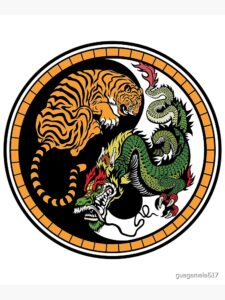
To understand the Tao in both its darkness and its light is essential in tapping into it. For this, I employ the Yin-Yang symbol, a Taoist symbol, which I will discuss with you, in all of its intricacies. Below is a diagram that may be useful for those who work better with visual aids like myself:
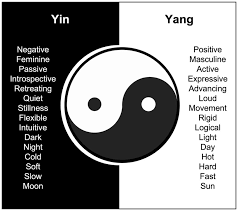
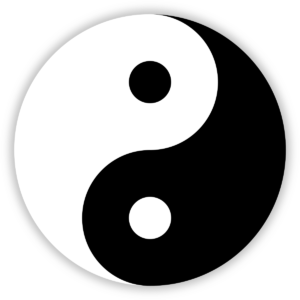
Yin is the feminine principle of creation, embodying darkness, night, cold, the Moon and other what we could call traditional feminine traits. Yang, on the other hand is the masculine principle of creation, embodying light, day, warmth/heat, the Sun and other what could be called traditional masculine traits. Without getting into gender theory (for the sake of simplicity, nothing else meant by that), I will iterate the belief that I’ve come to, not only in my study of Taoism, but also as a gender-fluid/non-binary person: that we all have within us, and should thus embrace, masculine and feminine traits. And that’s regardless of gender identity. Many other spiritual and magickal schools of thought embrace this idea, including Wicca and the Witchcraft community at large (obviously I generalize here). Another important thing to note, at least in my personal opinion, is that within both Yin and Yang, there is a small dot of the opposite within the other; this backs the concept of having both polarities within each of us, and also embodies the masculine potential within the feminine, and the feminine within the masculine.
The Tao as a Way to Enlightenment and Magick
In my years as a Witch and Occultist, I’ve found that magick is deeply effected by our personal affect, or mood. In psychological terms, an affect is a state of emotion, and can generally be thought of as your vibe for the day. Some days are better than others, sure; so is it wise to give ourselves a magickal boost when we’re feeling down? Well, yes, and no.
I’m sure many will agree, that when we’re angry, and trying to cast magick (save for malefic work), it generally doesn’t pan out, or pan out well. The same could be said for when we’re sad and trying to cast something to lighten our mood. The Tao may just be the key that many of you are looking for; embrace the lesson in the bad moods and hard days. Allow it to help you find your inner strength. Allow the Tao to bring you back to your center; you may just find that mood dissipate, or the racing thoughts slow down to a trickle that passes on down the stream in your minds’ eye.
Once we’ve reached that center, magick can be more effective; consider using crystals that match your intention, like citrine for lifting depression and bad moods, or rose quartz for grief and heartache. Amethyst is often called the Prozac of the crystal world, and as such can be a great ally for meditation. Another favorite of mine is Snowflake obsidian, as well as Mapstone Jasper; I refer to them both as having Yin-Yang energy, and imbuing balance and serenity, while also adding intuition and protection to the mix. Enlightenment isn’t always that “aha” moment, although it can be; sometimes, it’s also returning to center, to home base, and slowing down enough to hear nature’s heartbeat, as well as your own.
I’ve found that when I’m not in the greatest frame of mind, that Taoist practices and principles tend to ground and center me, bringing me into a place to practice magick to improve my situation, whether it be lifting my mood, finding more energy and passion to pursue my interests, which in itself is a form of self care, or anything else. I hope that this article, which very well could be the start to a series of articles on this and similar topics, has given you some inspiration and a potential turning point to embodying your Tao, which is the Tao of the universe, and connecting once again. From there, the possibilities are limitless!
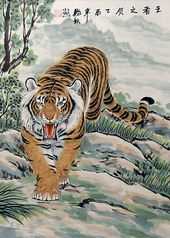
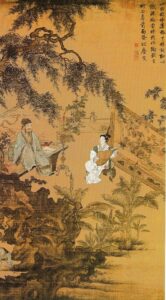
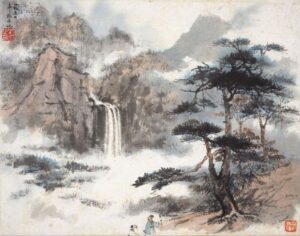
As a last side note, if you couldn’t tell, ancient Chinese and Taoist art are a particular favorite of mine.
Blessings,
The Modern Merlin
Resources on Taoism, Ancient Chinese Philosophy
Tao Te Ching by Lao Tzu (Penguin Classics version translated by D.C. Lau is a reputable copy)
365 Tao: Daily Meditations by Deng Ming-Dao
The Wisdom of the Tao: Ancient Stories that Delight, Inform and Inspire by Deng Ming-Dao
Everyday Tao: Living With Balance and Harmony by Deng Ming-Dao
The Book of Chuang Tzu (Penguin Classics translated by Martin Palmer is a reputable copy)
The Analects by Confucius (Penguin Classics translated by D.C. Lau is a reputable copy)
The Art of War by Sun Tzu (I have the newly released Sirius Hardcover classics edition translated by Nigel Cawthorne, and it has been a good copy to read)
***
Author Bio:
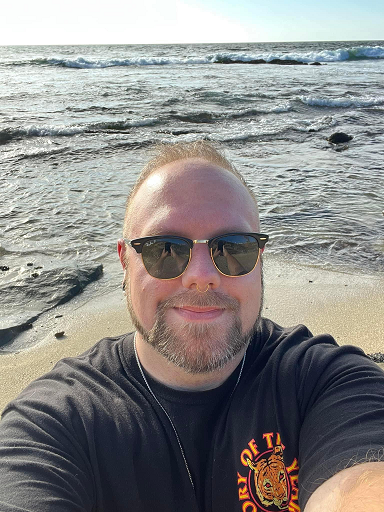
The Modern Merlin is a Polytheist, Pagan, Animist, Witch, Sorcerer, Chaos Magician and Occultist. He embarked on his spiritual and magickal journey over 15 years ago. As such, he has extensive knowledge of The Occult, Ceremonial Magick, Chaos Magick, Witchcraft, Sorcery, and both modern and ancient world religions and folklore. He is a practicing Sorcerer, blending ceremonial high magick, chaos magick and witchcraft, as well as plant medicine, poisonous plants and entheogens, shamanic techniques, and mysticism. He believes that magick can be as simple or as complex as one needs it to be, and rejects dogma, instead trusting his intuition, and encourages other magickal and spiritual folks to do the same! He venerates and casts magick with a wide array of spirits and deities, and works with both the Left and Right Hand Paths, having experience in both. He has also studied eastern philosophies such as Taoism, Zen Buddhism, and Hinduism. He is an Astrologer and Tarot reader and actively studies and practices many other forms of divination including Runes, Ogham, Palmistry and Scrying. An animal lover, he sees divinity in nature-the trees, plants, animals and sky. Also an avid reader, you’re hard pressed to not find him nose deep in a book, most likely on an occult, mystical, religious or magickal subject. He is the Co-Editor of PaganPages.Org and the author of multiple columns, including The Modern Merlin’s Corner, Entheogens for the New Gen, Stellium, and Scary, Strange and Mythical Encounters. He gives readings and other spiritual services through his Facebook Page, The Modern Merlin, as well other free informational posts for everyone to see! You can reach him on Facebook, or e-mail him at [email protected]