A Moment for Meditation
Mudra
I love mudra. It is a simple, yet fulfilling, peaceful part of meditation. Mudra is simply yoga for your hands. It is a Sanskrit word, meaning “seal”.
The ancient yogis found that each part of the hand and how it moves correspond to certain other parts of the body or the mind. It can also relate to your emotions, feelings and your behaviors.
There have always been hand languages and hand gestures in many of the cultures around the world. Look at paintings of Buddha, Jesus, many saints and religious icons; notice the hand gestures, palm open facing forward or fingers touching. These are mudras. Hand gestures were also used in ritual in Ancient Egypt, Greece and Indian; and, most likely in some traditions in modern day Wicca and Witchcraft. Even in today’s world, there is the ubiquitous handshake, hands in prayer and for some of us, the constant movement of our hands as we speak, to name a few.
There are many, many different mudras within the yoga and meditation world. The most used is gyan mudra but there are several others, which are listed below:
Gyan Mudra – The index finger and thumb touching; all other finger straight. This is for knowledge

Shuni Mudra – The middle finger and thumb touching. This is for wisdom,
patience and intelligence.
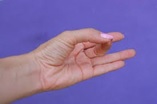
Surya Mudra – The ring finger and thumb touching. This is for vitality and energy.
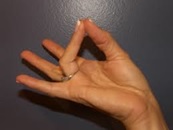
Buddhi Mudra – The pinkie finger and thumb touching. This is for communication.
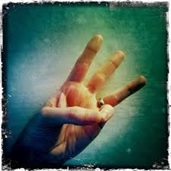
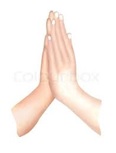
One of the other most commonly used is prayer pose, which is both palms touching, with hands held in front of the heart center. Prayer pose is for centering and calming. It is seen as the universal symbol of prayer.
Using these mudras during meditation effectively “seals” the effect of the mudra in your consciousness, hence the name.
While mudra should be practiced for a minimum of 3 minutes, they can be practiced anywhere. The energy from that connection will always be felt. Mudras can be used with mantra (see January, 2015 column) or without.
When speaking of your hands, the right hand is seen as the “receiver”, and is associated with the sun, and the left hand is seen as the “giver” and is associated with the moon.
The following are just three of the meditations with mudras that can help in this crazy hectic world in which we find ourselves. I hope that you will give them a try.
As we have discussed before, you will want to be in easy pose, or in a chair with a straight back. Your breathing will be long and deep.
Prayer Pose – Very simply sitting with your hands in prayer pose, with the breath, feeling yourself as infinity.
Cup of Compassion – Hands form a cup, with pinkies and outside of palms touching, facing upward. With the breath, visualize yourself receiving and accepting energy, guidance and blessings from the universe.
Preventing Stress – Hands are palm up; rest the back of the left hand in the palm of the right hand. Hands will meet in front of you an inch above the navel. Breathe long and deep.
These are but a few of the myriad mudras available to you. This video from YouTube may also be helpful:
https://www.youtube.com/watch?v=wN9n3ABjnIU&index=7&list=PL_dIya2JbVnTkujuSpjPc-hZV6LbKSnTX
If you have any questions, or would like further information, please do not hesitate to contact me at [email protected]
Namaste, Sat Nam & Blessings
Resources: Kundalini Yoga Sadhana Guidelnes – 2nd Edition
Healing Mudras – Yoga for Your Hands by Sabrina Mesko