Pagan Theology
Getting to work: Part 2
In the last column I discussed the relationship between various types of spiritual practices and the Pagan experience of the Gods and Goddesses. We talked about the eastern practice of meditation, western style prayer, and the use of physical and chemical means of disorienting the senses. In this column we’ll discuss ritual and occult magical practices as means of getting in touch with the divine.
Religious Ritual
Religious ritual is a common, nay universal, way of bringing deity into the world. While not all ritual works, or isn’t readily identified as ritual in the first place; the right ritual practice, at the right time, and under the right conditions, produces a sense of the holy. What characterizes a ritual experience of the divine? First, unlike the practices we discussed in the previous column where you do something inside or within yourself that produces the link with the divine, in ritual you reach out through a public, mediated, experience toward the divine.
Ritual is characterized by its repetition, public nature, embodiment of the public form of a religious doctrine (cultus), and general stimulation of the practical and symbolic senses of perception. All of these tools help form, or mediate the experience. You are appealing to an external set of objects or actions to provide a window into the divine. This is what I mean by “mediated,” which is something that helps you experience the divine. Magic is even more mediated than ritual, as that almost requires actions and objects in order for you to have the experience.
Ritual is the seeking of the divine within a community, whether it’s a physical community, or a temporal one. By physical community I am referring to the practice or ritual in groups. In groups like-minded individuals get together and go through steps that bring them a shared experience. But ritual can also produce a “temporal” community. Here it is the repetition of the same actions and ritual elements through time that produces a community that connects the practitioners across time and space, even though they are not physically present. Repetition of ritual in community that has also been practiced over time produces a bond with a much larger community.
Because ritual is connection with community, repetition is important. It creates a tie between past, present, and future religious community. It also gives what is done, no matter how outwardly silly or inconsequential, a gravity that comes from association with history and our ancestors. An example of history’s role in Pagan practice is the respect given in some circles to establishing pedigrees or genealogical histories for their practices. Practices, which are seen to have descended from historical sources, are given far more credibility than recent concoctions. Whether this is a result of the Abrahamic religions’ natural obsession with history, or a desire for depth and occult credibility by tracing back deep roots, it is something that seems like its important. Ritual is a way of “tracing back roots” as it becomes the repetition of a rhythm of worship amongst those who participate together over a long period of time.
Which brings us to the second aspect of ritual that is important, its public nature. Now, just because we call something “public” doesn’t mean that your neighbors have to witness you doing it. However ritual, in all its forms, is a calling together of the religious community for shared worship. So someone has to witness it, even if its just your partner is a very small coven.
Sure, solitaires can practice rituals in their home, but, by my definition of ritual, what they are doing is a series of actions that set up an internal state for connection. They are doing a form of meditation, prayer, or magic, not ritual. In some ways they are getting half of the experience of ritual, all the “show” but no “witness”. Religious ritual is intimately tied in with the speaking and witnessing of a public action. That public witness changes the space within which the action occurs. It could be said to change the “energy” of the action: because other people are watching what you are doing and through the watching, the action becomes different. In the witnessing of shared religious ritual we make it into something different than it would be without the observation. That difference is wrapped up with the presence of the other, the “not I,” that is present during the ritual. The “not I” of fellow witnesses reminds us, and manifests the greater manifests, and the greater, us “not I” of the Gods and Goddesses. It reminds us of the much more massive otherness of the Gods and Goddesses.
This goes back to my fundamental tenant of Paganism: the presence of the divine in the world. As Pagan Gods and Goddesses exist in the same way you or I do, then they also have the same sort of existential presence, the existential “nothingness” of consciousness. We are reminded of when we do something that is seen by others. The others remind us of the Gods and Goddesses, and in turn they remind us that the world is a subject, a being to be respected and given the credit of consciousness, as opposed to an object that can be manipulated by us without concern for the consequences of our actions.
This seeing of the ritual creates a space that is the sum product of all the consciousnesses that are present. At its essence ritual is an invocation of the widespread and multiple consciousnesses of the world by the fact it brings together the participants as a focused, conscious, and aware circle. The circle allows everyone to witness the ritual, to witness each other’s participation, and to create a space where the Gods and Goddesses are seen. To practice without community, means that we miss that connection to the world and the Gods and Goddesses.
Thus in the previous column we discussed the “private” acts of worship: meditation, prayer, and shamanistic journeys. Here with ritual we are bringing the public into our interaction with the divine. The introduction of the public brings both connection, in time and space to community, as well as observation. Ritual brings the world into our relationship and experience of the divine. And, being Pagans, our Gods and Goddesses are intimately connected with the world, the same way we are. So our rituals should in fact place us squarely in the world, right where the Gods and Goddesses are. Which is why participating in ritual, and I would add public ritual, is so important to Pagan practice. In the same sense our history, our real history, is important to understand. Because by understanding history we can begin to create a community that not only spans the practice in our current groups, but transcends both time and space. We become a community integrated across its history, and across the diversity of its practices when we understand our history, and other Pagan groups.
There is another way in which these same bonds can be forged, a way that is special to the Pagan practice. That is the occult practice of magic.
Magic
This is a column on the ways in which we engage with, worship, and connect to the Gods and Goddesses. It is not about the theory of magic. That requires a lot more thought, discussion, and time than we have here. Instead I would like to look at the use of magic as a way to connect with the Gods and Goddesses.
If ritual is the way we approach the Gods and Goddesses within the presence of the other, Magic is a way we approach them from within ourselves. Ritual is inherently public, shared, and selfless, magic is private, and generally all about the individual. In this sense it ranks with other “internal” ways to encounter the divine such as meditation and prayer (which is why meditation and prayer are encountered frequently in magical workings).
Now many ritualists and others are about to complain that magic has always been done in groups, so let me explain.
At its essence ritual is profession of faith witnessed by others. Whether those others are ancestral, dispersed through time and space, or actually present at the ritual, it is the witness of the other, the connection with another person, which changes ritual from a direct mystical experience of the divine into something else. Magic, on the other hand, is not witnessed in the same way ritual is, rather it is participated in by those involved. Likewise magic is not a mystical experience of the divine, as it is mediated by actions and words in the same way that ritual is mediated by actions and words (“ritual”). By “mediated” I mean that something comes between you and the divine experience, something has to be done, said, or be present (a statue) in order for the experience to happen. The experiences we talked about in the previous column, mysticism and prayer, are not mediated, it is just you and the Gods and Goddesses, and what you make of it.
Magic requires participation, and it requires mediation. In order to engage in magic you have to actually do magical practices, and you have to “do” something that causes the magic to happen. This is unlike ritual, where you don’t necessarily have to do anything actively associated with the ritual: you can simply witness it. In that sense magic is not something you can participate in by witnessing alone, it requires active involvement of the self. That is what I mean by magic being private; one inherent requirement in doing magic is that it is associated with individual action, not just group action.
So what does this mean? It means that magic and religious rituals are different. Doing ritual, as a way of connection with the Gods and Goddesses does not require magical practice, though in many existing concepts of ritual practice magic and Pagan ritual are intertwined. Often in the same way witchcraft and Paganism are intertwined in the United States and Britain where Wiccan practices have informed a lot of Pagan practice.
This duality between “public” ritual and “private” magic is a reflection of many different approaches to the problem of the role of religion in public life. For example, Max Weber’s concept of social action as applied to religion can be characterized as to whether the religious action transforms within (mysticism as an inner focused working), or within the world (magic as an action that occurs in the world). For example, salvation can be seen as deliverance from problems and troubles in this world, or the promise of a better life in the next. This duality between the pragmatic, social, and the otherworldly, abstract, is at the heart of religious action. For some indigenous religions it is the pragmatic, social, interactions that dominate, as religion is a cornerstone of social interaction within the clan or tribe. For other religions, such as many religions characterized as “New Age”, it is the inner workings, the inner experience of the divine, that is the key element of religious experience.
If mystical experiences and prayer are the way you seek after enlightenment and ritual is the way you build community and celebrate the Gods and Goddesses from within that community then Magic is where you end up if you are a Pagan and you want to get something done. Magic is religion divested of both community and transcendence; it is the practical tool that is used in a world full of spirit and deity.
Drawing on the duality discussed above we can divide the Pagan experience up into a two-variable space much in the way that others have. On the first axis is the degree to which our action is performed within us, or within the world. Ritual and prayer are actions that occur in the world, while magic and mysticism are focused within us. We call this the “world” axis, and it defines how much the activity affects us, or the world. The second axis, the “spirit” axis, defines what the goal of the working is. Is the goal mainly associated with connecting with the transcendent divine, or is it focused on connecting with or affecting the world. Prayer and Mystical experiences seek a connection with the transcendent, they cut us off from the world on interior or mystical journeys. Magic and ritual, on the other hand, connect us with the immanent divine within the world. They are actions that happen in the world, and seek to bring us to the Gods and Goddesses as they exist in this world. It is not surprising that magic and ritual are intimately connected with Pagan practices, while mysticism and prayer are actions that are shared with the Abrahamic religions. The figure illustrates these divisions.
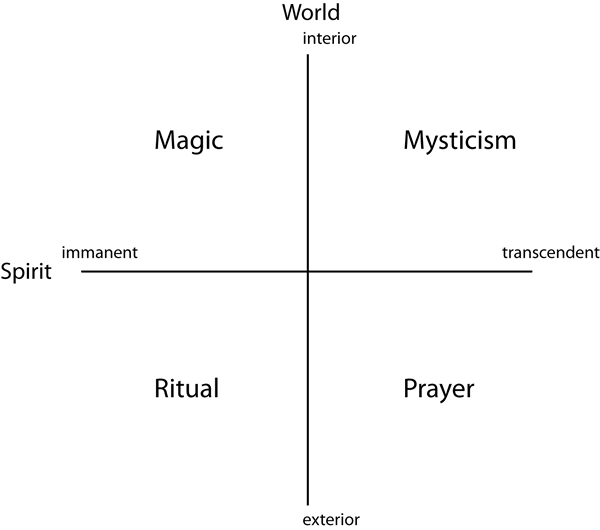
Magic is our attempt to affect the world in a practical way. With magic we seek a worldly way to connect with the divine in the world. Without a divine world, without the mystery of having immanent Gods and Goddesses, magic would not work. As we, too, are divine beings in a divine world (we are Pagans after all) the action of magic is our imitation, however imperfect or humble, of the Gods and Goddesses and their actions in the world. Magic is not so divorced from practical action; it merely is taking practical action to mimic the divine.
As a Pagan practice, magic is a way to communicate with the Gods and Goddesses in a way that no other religious practice has available. Because magic is acting in the divine world in a divine way, you are actually attempting to emulate the Gods and Goddesses actions and results. While our wisdom and ability are far less, magic provides a way to experience the divine directly, by being the divine, by attempting to act as they do in the world. Thus, while magic can be seen as the most debased way to experience the Gods and Goddesses, I’d claim that that is simply a prejudice held over from the book religions. If the Gods and Goddesses exist in the world, as I argue they do, then the whole world is infused with the divine. Doing something practical through magic in the world is harmonious with that divine world; it does not work against it. It is our ability to be the divine, to experience it in a practical way. Of course, as with any action in the world, what you do, and how you do it, will affect you and affect how you see the world, and how others see you.
This means that magic, unlike ritual, in an inherently self-ish activity, in the sense that it is self-centered. You do it, you then take responsibility for it. There is no way to put it off on someone else, like say a God or Goddess. As a way to connect with the Gods and Goddesses, magic is fraught with peril, the peril of self-centeredness, and ego. When we seek to behave like the Gods and Goddesses, we risk taking on the same moral and intellectual challenges confronted by divinity.
Unlike the three-fold law, which invokes the concept of karma, magic as imitation of divine action makes taking magical action even more dangerous and at the same time roots it firmly in the Pagan worldview of the natural divine. Screw up a magical working, either through hubris, selfishness, meanness, or stupidity, and the Gods and Goddesses are the ones you will answer to. To attempt divine action without divine wisdom would seem to require great caution, circumspection, and humility. This means that all our ethical concepts and ideas apply to magical action, not just the simple retributive three-fold law. We should behave ourselves magically because our magic determines who we are and how we approach the world. Behaving ourselves simply because we might be punished is something that smacks of the book religious ideas of sin and punishment for transgressions. We are more mature than that.
In all of this we have many different ways of reaching out to the divine world. We can attempt to communicate with the Gods and Goddesses directly, inwardly. We can experience them as part of a temporal or physical group through ritual, or we can attempt to “do as they do” to be like them through magic. This is a rich and varied set of ways to experience the divine, with far more opportunity, danger, and complexity than simply accepting a savior and going to church. It demands careful, thoughtful, action, and growth in order to reach the true destination of a Pagan experience: knowing the Gods and Goddesses.
And determined that drugs were a strange, and inappropriately syncretic, way of doing business. Don’t do drugs.
Note that I am using the term “ritual” as shorthand for Religious Ritual, which implies a ritual conducted in the context of religious activity, including worship. You have a lot of different kinds of rituals, from how you brush your teeth to what you do before taking a test. It is important to distinguish a series of repetitive actions (ritual) from community worship (religious ritual).
Which is understandable given that their primary truth-claim, one that forms the under girding of all three of their religions, requires that one dude (Jesus, Mohammad, Moses) be alive at one specific time and engage in some historically relevant actions.
Another tradition is occult groups such as the Rosicrucians and others seem always intent on constructing long and mysterious pasts that ultimately link them to Hermes Trismegistrus, Solomon, and the Egyptians. This desire for a link to deep history seems to be less a Abrahamic obsession and more of an underpinning of the occult group’s need to have a hidden or “occult” set of information that they can peddle to their members. Otherwise, without occult knowledge, they wouldn’t really be occult now would they?
I know that this is a controversial position that will be objected to by solitary practitioners. It is important to remember that I make several distinctions in my thoughts about Pagan practice. The most important is that Witchcraft is different from Pagan religion. You can be a Christian witch, but not a Christian Wiccan or Pagan (at least from the Christian perspective, Pagans are more or less like “whatever”). Witchcraft is a craft or practice that extends across religious practices, but is far more accepted and common amongst Pagan religions. Witchcraft can be practiced in solitary, or in groups. The methods of witchcraft, inner journeys (meditation), visualization, and shamanic journeys are inherently solitary practices, and not religious ritual, as I would define religious ritual. These practices are a part of a religious Pagan practice, but they do not convey the same things as public ritual practices do.
Ritual nudity as practiced by some Gardnarian Wiccans (and here and there by many other Pagans) certainly fits with the idea of a radical witnessing; it is a radical reminder of the fact that ritual witnessed is ritual that is connected to community and the world. While this fits theologically, I am totally suspicious about the motives and reasons why Gardner introduced these practices into revival British Witchcraft. I suspect that the reasons were not necessarily theological.
To “k” or not to “k,” that is the question. Ever since Crowley began putting a k on the end of the world magic, the question becomes whether we should follow the convention. I would argue we should not for a couple of reasons. First, it’s an affectation, and we don’t need more affectations. Second the definition of magic is perfectly fine, and it is extremely unlikely that anyone will be confuse it with stage magic when reading a magic tract (though people like Jeff McBride seem to be blurring some of the differences). Finally, I would argue that the correct way to reference what we do is “occult magic.” This differentiates it from nativist magic, which, while some people do it, is different from the ritualistic/Wiccan/Western tradition, and it differentiates it from stage magic.
See, for example, Sharot, Stephen. A Comparative Sociology of World Religions, New York University, New York, 2001, pp. 20-36.
This seems to be a fundamental dialectic process present in early 20th century philosophy of sociology, including people like Weber and Durkheim.
This holds true to Abrahamic magic, if all the divine is missing from the world, if the world is merely matter and energy, then magic or the supernatural, would not make any sense. This, amongst other things, could be seen as a Pagan influence on Christian practice when Medieval magic and ritual practices are considered.