A World Re-Enchanted December 2025
December in the Tolkienian Imagination: The Waning Light and the Hallowed Stillness
In a rendering of Middle-earth shaped for mortal understanding, the month that corresponds to December stands beneath the long shadow of the year’s turning. Though the Eldar do not reckon time by the same divisions as Men, they nonetheless perceive this portion of the cycle as an interval of profound quietude—a deep inhalation of the world itself before the sun begins its slow return. Among the Eldar, this season aligns with the late passage of Hrívë, the Winter season, when the air lies sharp with memory and the light thins like pale gold upon frost-covered lands.
For the Elves, this is a contemplative span, a time when their thought drifts toward the ancient griefs of Arda Marred. The solitude of the long nights awakens remembrance of the First Shadows, of the dark winter of the Trees, and of all that was diminished through the marring of the world. Yet this is not a season of despair; rather, it is a solemn honoring. The Eldar hold that in the deepest hush of winter, the Music of the Ainur becomes most discernible to the heart. As the external world grows still, inner hearing grows clear.
Among Men, especially in Númenor and its cultural descendants, this period came to represent the waning of the solar year and the nearing of renewal. Mortal peoples felt more keenly the fragility of the sun’s warmth; they watched the fields slumber under frost and knew well their dependence on the promises of returning spring. Thus, December became associated with hearth-fires, preservation, and the quiet endurance of hope. Old tales speak of songs kept for the Longest Night, weaving remembrance of Eru’s Gift and the steadfastness of the Edain in ages past.
In Dwarven tradition, the last turning of the year was an honored time of craftsmanship. Stone halls rang with the measure of hammers not in frenzy, but in rhythmic deliberation. For the Khazâd, the deep cold brought clarity—a sharpening of purpose as the year’s work drew toward completion. They regarded this span as a fitting time to finish labors long undertaken, to set gems into their settings, to carve the final lines into stone, or to commit treasured lore to runes.
Across Middle-earth, whether by Elf, Man, or Dwarf, the season corresponding to December held a unifying character: the world seemed pared down to essentials. Wind, stone, star, and night revealed their bare contours. It was as though Arda itself whispered of both its woundedness and its enduring beauty. Many traditions recognized this month as a liminal threshold—a hinge between darkness and the first glimmer of returning light.
Thus, in a Tolkienian understanding, December is not merely the closing of a calendar, but the deep stillness in which memory, sorrow, and hope mingle. It is the quiet chamber of the year, where the past is honored, the present is steadied, and the first seeds of renewal are felt beneath the frost. It is a time when the hearts of the Children of Ilúvatar—Elf and Mortal alike—turn inward toward reflection and outward toward the faint yet steadfast promise that light, though diminished, is never vanquished.
December Magical and Mundane Tasks
Celebration and Renewal
Theme: Festive Connection
- Magical:
- Celebrate Yule with a ritual of light and togetherness.
- Craft or gift magical items (e.g., charms, spell jars) for loved ones.
- Perform a year-end reflection ritual to honor your journey.
- Mundane:
- Celebrate with family, friends, and community through holiday traditions.
- Document your year’s journey through photos or writing.
- Set new intentions for the upcoming year.
Valar of November – Nienna
Nienna stands among the most spiritually arresting of the Valar, a figure whose presence in Tolkien’s cosmology reveals the sanctity of compassion, grief, and endurance. She is the sister of Mandos and Lórien, yet her path diverges from theirs: she is the Mourner, the one who beholds all sorrow without turning away, and in doing so transforms affliction into a wellspring of wisdom. Her tears are not signs of despair but of a profound empathy that reaches to the roots of Eä itself—an empathy that teaches others to suffer rightly, to endure with dignity, and to allow pity to blossom into strength of heart. In Tolkien’s wider mythic vision, Nienna’s influence is subtle yet pervasive; she shapes the moral texture of Middle-earth, nurturing mercy in those who listen, and guiding the broken toward a deeper understanding of hope.
Incantation to Nienna, Lady of Enduring Compassion
Nienna, whose gaze rests upon all sorrow,
I open the quiet places of my spirit to your presence.
Let the veil of my grief fall into your keeping,
that I may behold its shape without turning away.
Teach me the strength that dwells within lamentation,
and the clarity that rises from honest sorrow.
Guide my heart to receive the weight of the world
without surrendering to bitterness or retreat.
May your patience steady my breath,
and your compassion temper my resolve.
Walk with me in the stillness beyond consolation,
where endurance becomes insight
and the wounded spirit learns to rise unbroken.
Full Moon of December – Isilringarë
The Moon of Frosty Cold and the Mourning of Arda Marred
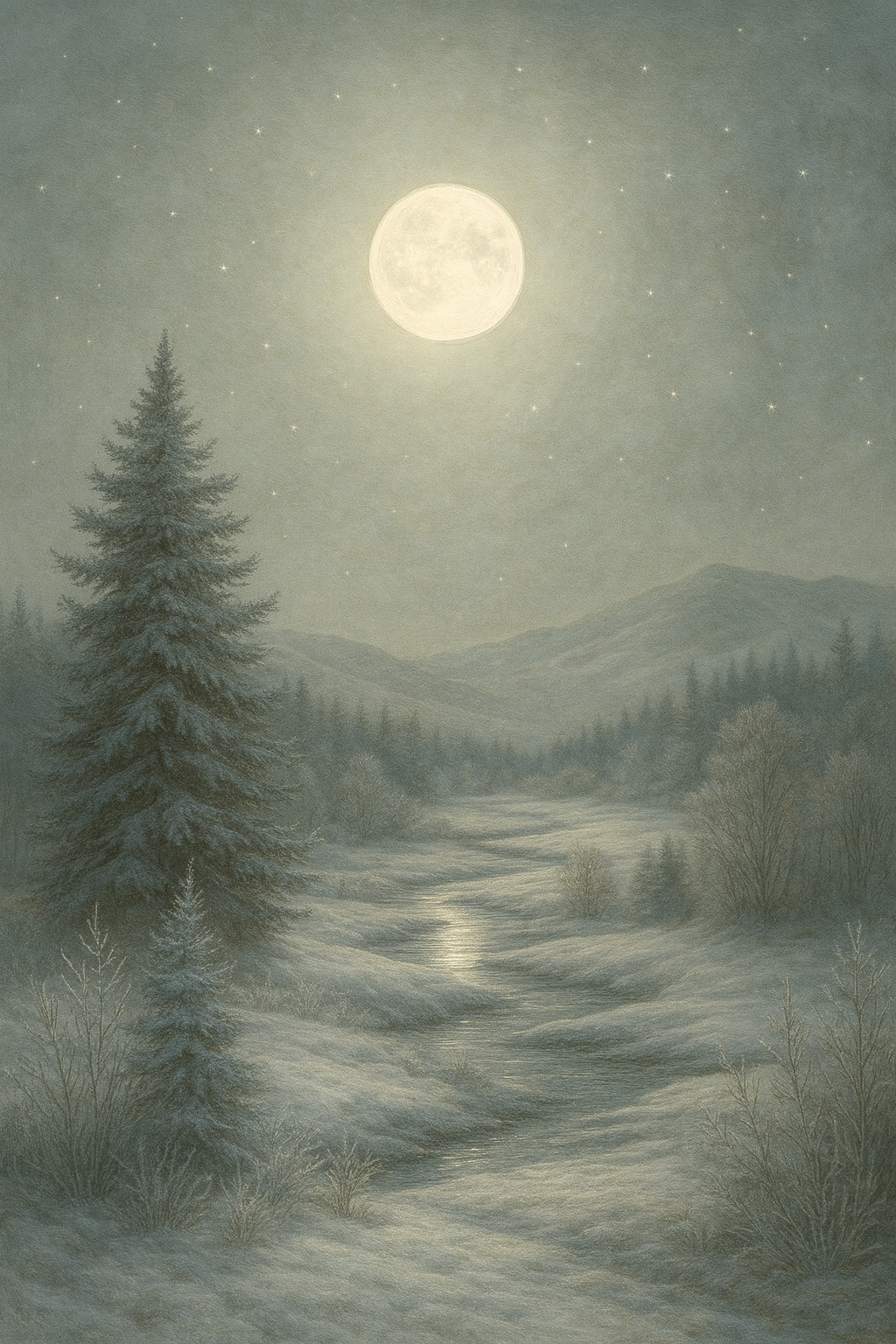
Isilringarë, “the Frost-Ring of the Moon,” is the full moon nearest to the Winter Solstice in traditions that draw upon the cosmology of Tolkien’s world. Its name evokes both the crystalline stillness of midwinter and the pale, encircling radiance of Isil, the Moon wrought from the last blossom of the Silver Tree, Telperion. When Isil stands in its highest brilliance during the year’s darkest turning, its light is said to deepen rather than dispel the mystery of winter: a cold fire that illuminates the world’s stillness without altering it.
In Elvish lore, Isilringarë marks the moment when winter reaches its inward peak—when stillness becomes almost sacred. The Eldar observe this full moon not as an omen of death, but as an expression of purity, endurance, and clarity. The air is sharp, shadows long, and the land seems to pause in a state of suspended breath. Many Elves speak of this moon as the one closest in “mood” to Telperion itself: silver, cold, contemplative, unadorned by the gold of Laurelin.
Its light is believed to have an introspective quality, revealing the inner lines of things. Snowfields seem etched with secret geometry; water freezes into patterns that resemble the starlit Devices of Varda; and even the silence becomes eloquent. For the Eldar and others attuned to such meanings, Isilringarë is a time for clarity-seeking—quiet vigils, the reviewing of memories, and the discerning of purposes for the year to come.
The Mourning of Arda Marred
Yet Isilringarë carries another, deeper note: it is the moon under which many recall the grief of Arda Marred, the wounding of the world wrought by Melkor’s rebellion. The imagery of a cold, perfect light shining upon a world that no longer reflects its original harmony is profoundly symbolic. On this night especially, the Eldar sense the dissonance between what was intended in the Music of the Ainur and what has come to be.
Isil’s own history intensifies this reflection:
- It was born of Telperion, one of the Two Trees destroyed in the first great act of the Marring.
- It rises and travels in patterns shaped by the defiance of Melkor and the labors of Tilion.
- Its beauty, though profound, is always touched by a sense of loss—the echo of a perfection that cannot be wholly reclaimed within the Circles of the World.
Therefore, during Isilringarë, many Elves hold moments of solemn remembrance. They recall:
- the dimming of the light of the Trees,
- the sundering of the Elven kindreds,
- the ancient sorrows that echo in later ages,
- and the world that still bears wounds beneath its snows.
This is not a despairing grief but a contemplative one—a recognition of the brokenness of Arda and a silent vow to uphold beauty, truth, and healing in defiance of the Marring. For Men and other Free Peoples who adopt this observance, it becomes a moment to acknowledge the fractures within themselves and their world, and to reaffirm the slow work of mending.
Symbolic Synthesis
Isilringarë thus stands as a paradoxical moon:
- bright yet cold,
- beautiful yet mournful,
- a sign of endurance in a marred world.
Under its silver frost-light, practitioners often engage in quiet rites of reflection or renewal, honoring the sorrow woven into Arda while also remembering that even within the Marring, the light of the Trees endures—changed, but not extinguished.
Incantation to Isilringarë, the Frost-Moon of the Marred World
Isilringarë, argent sentinel of the winter sky,
I stand before your cold and hallowed light.
Let the stillness you cast upon the frozen land enter my breath and steady my heart.
Let the clarity woven into your frost-lit paths open the inward places where truth dwells unspoken.
You who shine with the memory of Telperion’s last radiance,
bear witness to the grief that lingers in the bones of Arda.
I acknowledge the wounds that time has not yet mended, in the world and in myself,
and I offer them to your silent illumination.
May your pale fire reveal what endures beneath the long dark.
May your steadfast course teach me to continue with purpose even when the way is veiled.
May your presence remind me that beauty persists, though shaped by loss, and that all healing begins in the quiet of recognition.
Isilringarë, guardian of the solstice night,
let me walk in your argent calm.
Let me see the hidden lines of being.
Let me hold the sorrow of the world without faltering,
and rise from this vigil with renewed resolve toward the mending of what can be restored.
December Holidays
21st
Turuhalmë: The Turning of Winter in Elven Tradition
Turuhalmë—“the drawing of the wood”—is an Elven observance marking the quiet turning of winter and the first stirrings of renewal. Rooted in Tolkien’s linguistic notes, the festival is associated with the Winter Solstice and reflects the Eldarin sense that every seasonal change echoes the deeper harmonies of the Music of the Ainur.
A Festival of Endurance and Hidden Light
Rather than a jubilant celebration, Turuhalmë embodies stillness, memory, and the persistence of life concealed beneath winter’s frost. It centers on the hearth, storytelling, and reflection upon the past year. For the Eldar, winter was not death but concealment—a veiling of the Light that yet endures.
The festival affirms:
- Light veiled, not lost
- Hope resting beneath the world’s surface
- Communal endurance and shared remembrance
Traditional Eldarin Observances
- Drawing of the Logs — Special wood, often with personal significance, is brought out and placed upon the hearth as an offering of warmth and gratitude to Yavanna. The logs symbolize the year’s stored vitality returning as light.
- Rekindling the Winter Flame — A steady, contemplative hearth-flame echoes the Fire Imperishable and invites meditation on resilience, inner light, and companionship.
- Story and Song — Elves recount tales of Cuiviénen, ancestral journeys, and genealogies, preserving memory through quiet, reverent storytelling.
- Star-Vigil — Stepping into the winter night to gaze upon Varda’s stars, the Eldar renew their orientation toward hope and remember their earliest awakening beneath starlight.
- Simple Gifts — Small handcrafted tokens—wood carvings, leaf ornaments, runic blessings—are offered as gestures of affection and artistry.
- Quiet Remembrance — A moment is set aside for those who have passed to Mandos, honoring the unbroken threads of memory.
- Winter Foods — Warm, comforting fare such as seedcakes, preserved fruits, herbal teas, and simple stews is shared in an atmosphere of calm fellowship.
Adapting Turuhalmë Today
For modern Tolkien-inspired practitioners, Turuhalmë offers a practice of introspection and renewal at the heart of winter. Contemporary observances may include:
- Lighting a winter candle in honor of the Secret Fire
- Crafting small wooden charms or runic tokens
- Reading passages on Cuiviénen or Varda
- A silent star-vigil outdoors
- Reflective writing on the past year’s endurance
- Sharing a simple, mindful meal with loved ones
Turuhalmë invites us to recognize the hidden resilience woven into both nature and the self—the quiet promise that even in the deepest winter, light waits to rise again.
Next Month Preview
As the thirty-first day descends upon the waning year, mortals observe the quiet threshold where one cycle releases its final breath and the next prepares to rise with the dawn. This moment—held between remembrance and renewal—mirrors the deep stillness known to the Eldar at the turning of winter, when light grows thin yet steadfast. In this spirit, a New Year’s Eve column will mark the close of the present season of writings and the gentle turning toward a new direction. Though the perspective shall remain rooted in the lore and sensibilities of Tolkien’s world, the path ahead will open to fresh considerations and newly kindled themes.
With the coming month, the full moon ascends under the name Isilnarvinyë, the “Moon of the New Fire,” the returning of the sun.
The Valar most attuned to this span is Aulë, whose patient craft and enduring vision resonate with the year’s beginning, when foundations are laid quietly beneath the surface of days.
No ancient festival of Arda falls within this month, yet its unadorned stillness invites reflection, intention, and the shaping of inner resolve.
As we step into this new turning, may our shared study of Arda’s lore deepen in richness and widen in scope. And may we, through mindful practice and renewed wonder, continue the quiet labor of weaving A World Re-Enchanted, remembering in small yet faithful ways the ancient harmony that once flowed through all the works of Eä.