Across the Great Divide

Science and Psychics- The Tech of Paranormal Research
Most of the intellectual rhetoric thrown back and forth between skeptics and parapsychologists concerns the types of tools used during investigations; sometimes even those within the field of psychical research will argue among themselves for or against certain techniques and tools.
Since the field is one which attempts to quantify and classify phenomena that are, by definition, cultural, religious, and fundamentally unknown, it is somewhat acceptable to utilize devices and techniques of a more “mystical” nature. Many times the use of arcane devices and psychics can help lead the team to an area of interest or heightened activity, and sometimes even actual contact with the netherworld.
Once these devices or techniques have pointed the way to the presence of activity, the seasoned researcher will switch to more scientific instruments to document any possible activity. Unfortunately, the truth is that at the end of the day it doesn’t matter what kind of personal experiences, thoughts, feelings, intuitions, or psychic imagery is collected, or by whom- if it can’t be verified or quantified through impartial scientific measurement and documentation, then it technically never happened and just becomes yet another account in the mythos of a location’s “ghost stories.”
Tools have been modified or adopted from various sciences and applications over the years to measure and analyze data in a paranormal investigation. Some devices are used specifically to debunk phenomena and establish clear natural causes; while others have the purpose of capturing evidence- such as voice and video recorders. EMF detectors have a unique function of being used both for the debunking and the signifying of paranormal activity.
However, regardless of how expensive or scientific the tools, they are only as scientific as the person using it; a team may boast about owning the most sophisticated thermometer available, but if members are using it as a barometer, the measurements are worthless; Just as using a calculator doesn’t make you a mathematician, using a Geiger counter doesn’t make you a scientist. In the wrong hands the most accurate measurement device is nothing more than an expensive toy.
All paranormal research groups have their own unique procedures and instruments of choice. Some are religiously-based and use age-old tools and techniques; some consider themselves ultra-modern and use only the most expensive and scientific of equipment. Most groups, however, fall somewhere in the middle; and the tools, techniques, and even the very members come from a vast array of backgrounds, philosophies, and religions. The make-up of these groups and the tools they use are contingent on finances, personal preference, and practicality.
We’re all familiar with EMF detectors, and I’ve gone over at length the ins and outs of video and audio equipment; but as I mentioned earlier, some of these tools are of a more arcane nature and we’ll focus on that this time around.
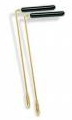
The use of dowsing rods for various functions goes back thousands of years. They have been used to find water in new settlements, material objects, fortune telling, and various religious applications. Essentially, a pair of L-shaped metal rods made of brass or lightweight metal are held loosely in each hand and will remain straight or static during normal conditions, but when in the presence of paranormal activity they will begin to move erratically or cross when directly over, near, or in direct contact with paranormal activity. Interestingly, during the Vietnam War, U.S. Marines even used dowsing to locate weapons and tunnels.
Traditionally, the divining rod was a Y-shaped branch from a tree or bush. Different cultures preferred the branches come from particular trees- hazel twigs in Europe and witch-hazel in the United States. Branches from willow or peach trees are also common. Both skeptics and many of dowsing’s supporters believe that dowsing apparatus have no special powers, but merely amplify unnoticeable movements of the hands resulting from the expectations of the dowser. This psychological phenomenon is known as the ideomotor effect and boils down to basic mind over matter. Your mind is signaling the muscles in your body to make subtle movements that are unnoticeable to the naked eye. Some supporters agree with this explanation, but insist that the dowser has sensitivity to the environment; other dowsers say their powers are paranormal.
The American Society of Dowsers admits that “the reasons the procedures work are entirely unknown.”
Research focusing on possible physical or geophysical explanations for dowsing has been conducted in recent years. For example, Russian geologists have made claims for the abilities of dowsers, which are difficult to account for in terms of the reception of normal sensory cues. Some authors suggest that these abilities may be explained by postulating human sensitivity to small magnetic field gradient changes. One study had even concluded that dowsers “respond” to a 60 Hz electromagnetic field, but this response does not occur if the kidney area or head are shielded.
Whatever the evidence for or against, dowsing will undoubtedly continue to be used in the course of investigations. Those that swear by their results will present evidence to support their claims, and skeptics will chuckle at the “superstitions of ages past.”

Another example of this type of tool is the pendulum. A pendulum is a small dowsing tool composed of a dangling crystal or metal plumb which is used to answer questions or find things through psychic energies. Answers are determined by the direction of movement to preset variables; the most common formation is back and forth for yes, circular for no. Pendulums are used in much the same way as dowsing rods and similar to function and result. Due to its design of both answering specific questions and ability to detect or be affected by paranormal activity, the pendulum can be considered a hybrid between the centuries-old dowsing rod and the Ouija Board of Spiritualist fame. Skeptics also point out the high probability of the ideomotor effect.
One device I have to mention, as it’s come up in conversation a lot lately, is called the Ovilus.
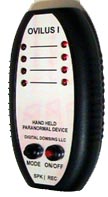
This odd gadget blends the psychic and the scientific into an all-in-one tool- an EMF, audio recorder, dowsing rod, and K-II that turns EMF into phonetic speech by translating the readings into numbers, and those numbers into words, sounding them out using text-to-speech algorithms via a vocabulary of 512 words. Various modes include speech mode, using the environment to pick the words to say; phonetic mode, using the environment to create words phonetically; commutation mode, using speech mode and phonetic mode together, EMF Mode; yes/no mode, to ask questions and get yes or no answers (a digital Ouija?); level mode, to watch the energy change in the environment; and dowsing mode, to work like a pair of dowsing rods. It is equipped with something called the Paranormal Puck. The Puck is designed to aid in paranormal research and meant to be the “center” of investigation. A place to gather, log, track, and maintain the data it watermarks to prevent tampering.
Every time I try to justify this thing, all I can picture is Dug and the other dogs from Disney’s Up!
Users note that it can be “randomly repetitious” at times by stating selected words for every question asked and every environment investigated.
The first question that comes to mind is how can the inventor of this device possibly test the results? Whatever formula they use to equate EM energy with words would have to start as an arbitrary guess. It would then need to be tested repeatedly to verify the results.
In the end, the most important thing to take away from this is that whatever tools or techniques you or your group are using, as long as it is used correctly and truthfully then happy hunting.
So, dear readers, what kind of experiences have you had using these types of tools? As always, the floor is now yours. Please share.
© 2011 R. Wolf Baldassarro/Deep Forest Productions