Notes from the Apothecary
Notes from the Apothecary: Lovage
It is an herb of the Sun, under the sign of Taurus. (Culpeper, 17th Century).
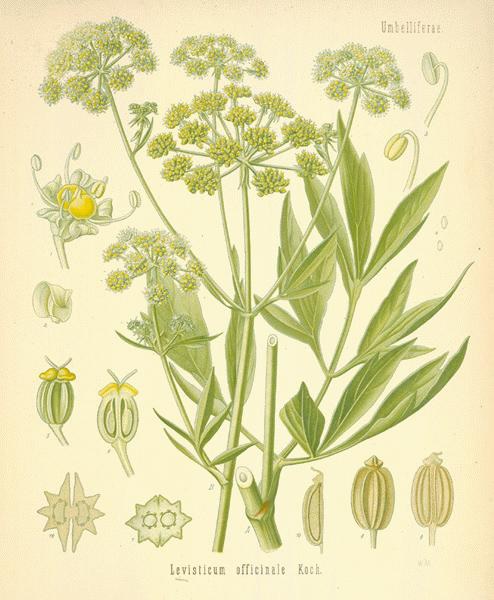
Lovage is a tall, beautiful, leafy herb in the same family as Angelica and carrots. Similar in aroma to celery, this herb is just as edible if not as popular in our modern kitchens. It is native to Europe and Asia, so may be harder to find in the Americas, however you can certainly buy seeds online to grow your own. The name may originally have been ‘love-ache’, which actually means ‘Love Parsley’, which is understandable as the leaves have a similar shape and smell to flat leafed parsley. The ‘love’ part is simply an Anglicisation of the original Latin name, Levisticum, which may be derived from ligusticum, which means ‘Of Liguria’, a place in the north of Italy where the herb was prolific.
Lovage may have an emmenagogue effect (may encourage bleeding from the uterus) so please don’t use when pregnant or trying to conceive.
The Kitchen Garden
The first thing you have to think about when growing Lovage is ‘Do I have room for this?’ as the stuff gets massive! Growing up to 72 inches tall, it has a wide spread of up to 32 inches so needs a good bit of space. It also needs sandy or loamy soil, so might struggle in claggy, clay filled soils. It needs to be started indoors, and can be moved outdoors once there is no risk of frost. You could keep lovage as a ‘cut and come again’ plant on the window sill, but you’d miss the opportunity to harvest the thicker stems that can be used like celery, and even the roots can be used once the leaves have started to die back.
Lovage leaves make an excellent, flavoursome addition to a salad, or as a stuffing for meat and poultry. Hugh Fearnly-Whittingstall raves about the stuff, recommending it mixed with summer veg, scrambled eggs, new potatoes and all manner of soups.
The seeds and roots have been used in the flavouring of candies and sweets.
In Joanna Asala’a Celtic Folklore Cooking we learn that the roots and seeds of lovage were often used as a substitute for pepper, to add a piquancy to dishes.
The roots can be cooked like potatoes, in stews or casseroles. This is truly a diverse culinary plant.
The Apothecary
Culpeper tells us lovage is the remedy for sore throats, poor digestion and ‘gripe’ (bad or trapped wind). He noted that it ‘mightily provokes women’s courses’ which rings true with the modern research that tells us lovage stimulates the uterus.
Culpeper also noted that dropping a decoction of the herb into the eyes removed redness and dimness, however I wouldn’t recommend this without more modern advice!
Mrs Grieve’s Modern Herbal tells us that the herb was widely used in the 14th century, predating Culpeper’s works. It seemed it was taken as a general ‘cure all’. She advised the herb has a carminative action, and especially useful in dealing with colic in children.
The Lab
Modern research backs up the use of lovage as a ‘GI’ drug (gastro-intestinal) as the herb gently encourages natural processes such as saliva production and gastric juice production, improving digestion.
Lab tests also proved that lovage can dissolve phlegm in the respiratory tract. There are also reports of the plant having sedative and diuretic effects.
The Witch’s Kitchen
Any reputation lovage has as an aphrodisiac or love tonic is purely a case of mistaken identity. As mentioned previously, ‘Love Parsley’ actually meant ‘Parsley from Liguria’, and it was because the English mistakenly included the word ‘love’ that people assumed the herb would be useful for love potions. In other words, the name came before the use!
Asala tells us that lovage was brought to Celtic lands by the Romans, and that travellers would place the leaves in their shoes to relieve fatigue.
The stem is hollow and you could use this to represent a pipe or musical instrument on your altar.
As an herb of the Sun, you could also use the leaves or flowers to represent the cardinal direction of south, or the element of fire.
As expected with these correspondences, the herb is masculine so bear this in mind if using in incense or poppets. I always try and balance my concoctions, unless I am going for something that is particularly masculine or feminine.
Home and Hearth
To bring balance to a volatile situation:
Pick fresh lovage leaves if possible. If not, use some dried seed. Tear the leaves or sprinkle the seed into a metal, pot or glass bowl. Add to the lovage about the same amount of jasmine, either fresh or dried. I like to use the dried flowers, which I order from my friendly online herbalist.
Stir the mixture deosil (sunwise/clockwise) with your finger chanting
Male and female
Sun and moon
Bring me peace
And balance soon.
Repeat this several times until the words and the aroma of the herbs fill your mind. As your mind begins to calm, visualise the outcome to the situation you want. Thank the herbs and any spirits or deities you may have involved.
You can repeat this as often as you like until the herbs lose their potency. This is either when they lose their aroma, or when there has been a full cycle of the moon.
I Never Knew…
Lovage was eaten by the Scandinavian people most now refer to as Vikings, and is even thought to be a favourite herb of Lofn, handmaiden of Frigga.