Book Review – The Small World I Ching by Peggy Jones
Book Review
The Small World I Ching
by Peggy Jones
Publisher: Tortoiseshell Publishing
90 Pages
Publication Date: September 14, 2021
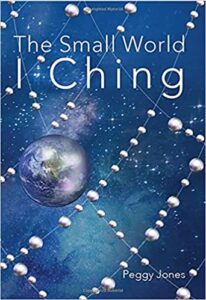
I have been a devotee of the I Ching since I found the classic I Ching: The Book of Change by John Blofeld at a library book sale way back in 1985 – a paperback which seemed small but was packed with a ponderous prose that was often almost impossible to understand. To this day, my handwritten notes are stuffed in between the pages because I so often felt like I was flying without manual instruments – just going on instinct. I would throw my pennies and try to figure it out as I went along, hoping that I didn’t crash into some divinatory mountain along the way.
The Small World I Ching by Peggy Jones (published by Tortoiseshell Publishing, in conjunction with WRITERSWORLD) is a much simpler read! It’s the perfect book for a beginner – which I consider myself still to be – since Jones focuses on the basic meaning of each of the sixty-four hexagrams. Breaking them down into the four elements of air, fire, water and earth, she then expands these concepts into two forms each – for instance, water can be deep and flowing as in a “canyon” or limited, like a “lake”. (Jones, xiii). Each element has its alternative motions, which is reflected in the hexagrams.
Still in the introductory section, Jones sets out the “Method” for consulting the I Ching. Like most books I have read about the I Ching, she advises using three pennies, but she also has a few other methods to offer. What I really liked is her other advice – which could apply to any divinatory method you’re going to use – I really liked the method of imagining a “stage, as in a theatre” on which you “place your current concerns, crisis, hopes, dreams on it; gather the individuals who are currently actively engaged with you and part of the ‘play’ that is going on, even if they are in the wings, in the audience, backstage, doing the lighting…” She goes on, “Theatre is an imaginal space where things are created and found, is you are open enough. If not, you won’t find anything, although something may still find you…” (Jones, xvi-xvii)
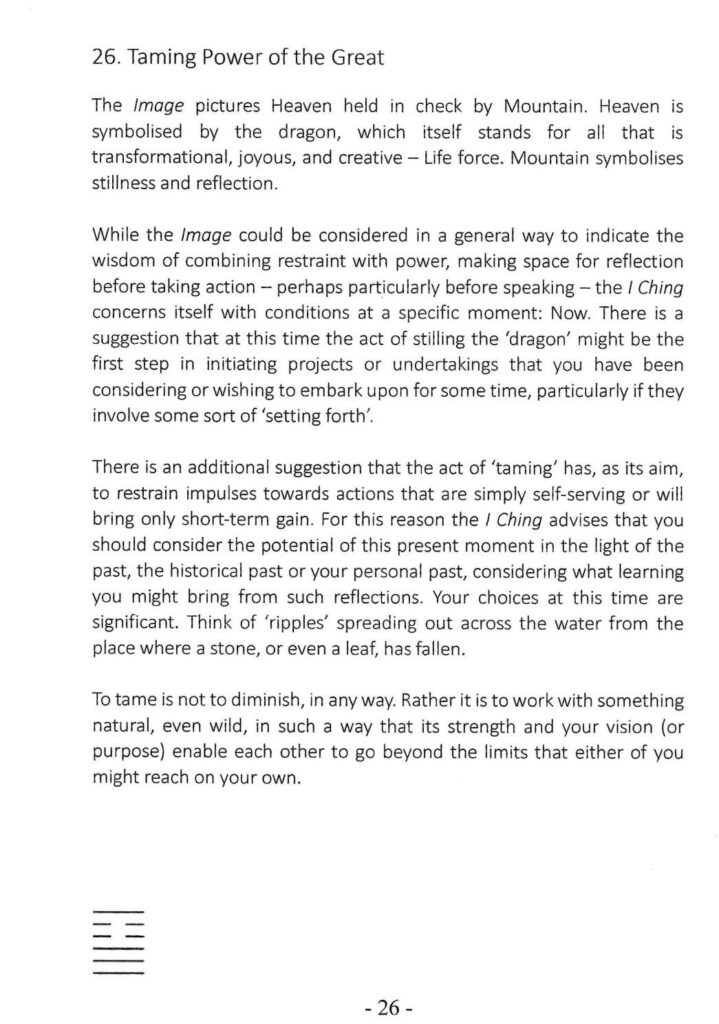
The next section of the book contains the images of the sixty-four hexagrams themselves. There is one per page, so the description of each is clear and concise. The title of the hexagram is at the top of the page and the image of the hexagram is at the bottom of the page, at the outer edge, with the explaining text in the middle. Each page looks as clean as a well-tended garden. Here is an example:
Of course, you can read through a book like this – you can read dozens of books like this – but learning theories are meaningless unless you put them into practice – so I dug three shiny pennies out of the ceramic kitty in which I keep my copper change and I readied myself for divination.

I thought seriously about the theatre aspect as I warmed the pennies in the palms of my hands before I threw them. My son is bringing home his new girlfriend for Thanksgiving weekend and it will be the time meeting her, although I have heard lots about her – she’s a great cook, he says – and she collects tarot decks, like I do – and we’re friends on Facebook, now – so I know what she looks like – of course, she’s gorgeous. So I thought about a scene where my son comes home with his new girlfriend and Thanksgiving dinner with the family and how that would all play out.
I started throwing the coins. I carefully took notes of what I threw. If you have never done this before, the Appendix A on page 66 tells you exactly how this is done:
“You are going to throw all three coins six times and create a six-lined figure, a hexagram, from the bottom up – it grows like a tree: from the bottom up. Throw the coins for the first time and total their value, which will be 6,7,8 or 9…Write that number down, leaving space for the hexagram to grow above it. Throw all three coins five more times and make note of the numbers in a column, 1st throw at the bottom, 6th throw at the top.”
She continues:
“Now, if the number is 6 or 8, enter a broken line next to that number: Yin = 6 or 8 (= broken line). If the total is 7 or 9, enter a solid line next to the number: Yang = 7 or 9 (= solid line). You will now have a six-line figure, a hexagram.” (Jones, 66)
At this point, you will want to consult Appendix C to figure out what hexagram you have thrown.
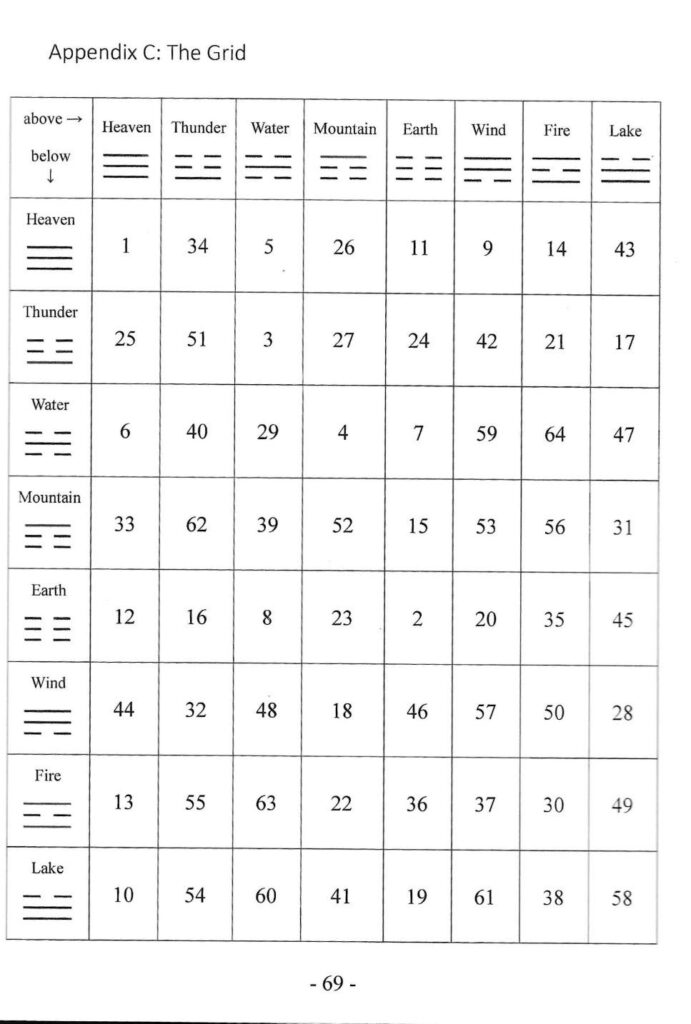
Now, with all this in mind, I threw my coins and drew my hexagram – from the bottom up! – and this is the hexagram I divined:
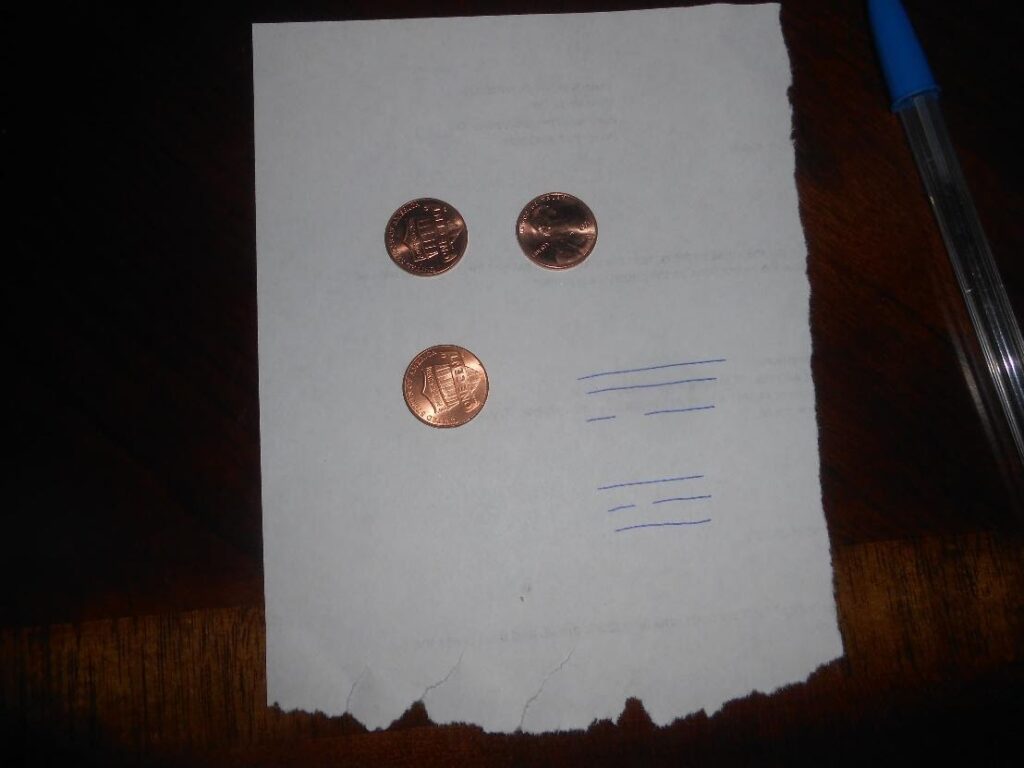
I looked it up on the chart and it was Hexagram 37 – the Family or Clan. Considering what I had been thinking about as I threw the coins, I thought this was most auspicious!
Jones writes, “The nature of communication within the family (past and present), and between the family and the wider world is reflected in the Image, where wind and fire speak of a mutuality of influence between the ‘within’ and the ‘without’.” (Jones, 37)
I really love this little book. You can’t go wrong with The Small World I Ching, by Peggy Jones, published by Tortoiseshell Publishing in conjunction with WRITERSWORLD, especially if you’re new to the I Ching. I highly recommend it. I fully plan to look for and purchase Jones’ other book about the I Ching, The I Ching: Points of Balance and Cycles of Change, as I am fully and completely impressed with her clear and concise writing style and her divinatory knowledge. Although she doesn’t have a website or presence on social media, she proves that none of that is necessary to reach an open mind. Please – open your mind – find this book. You won’t regret it!
Peggy Jones is the author of The Small World I Ching, The I Ching: Points of Balance and Cycles of Change, and Benches.
The Small World I Ching on Amazon
**
About the Author:

Polly MacDavid lives in Buffalo, New York at the moment but that could easily change, since she is a gypsy at heart. Like a gypsy, she is attracted to the divinatory arts, as well as camp fires and dancing barefoot. She has three cats who all help her with her magic.
Her philosophy about religion and magic is that it must be thoroughly based in science and logic. She is Dianic Wiccan but she gets along with a few of the masculine deities. She loves to cook and she is a Bills fan.
She blogs at silverapplequeen.wordpress.com. She writes about general life, politics and poetry. She is writing a novel about sex, drugs and recovery.


