Greetings from Afar
General Curtis E. LeMay
The Man Who Most Likely Knew it “All”
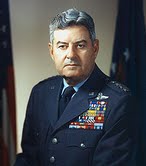

General Curtis Emerson LeMay (November 15, 1906 – October 1, 1990) was a four-star general in the United Staes Air Force and the longest tenured commanding officer of any independent command in the United States military.
He is credited with designing and implementing an effective, but also controversial, systematic strategic bombing campaign in the Pacific Theatre of Operations of The Second World War. During the war, he was known for planning and executing a massive bombing campaign against cities in Japan. After the war, he headed the Berlin Airlift, then reorganized the Strategic Air Command (SAC) into an effective deterrent to and instrument of nuclear war..
General LeMay was one of the most well known, and controversial generals in the history of the United States Air Force, particularly in the period immediately following World War II. He was probably the best known as the Commander in Chief and architect of Strategic Air Command, and has been made famous in film, in both fictional and semi-fictional portrayals, ranging from James Stewart’s “Strategic Air Command” to Stanley Kubrick’s “Dr. Strangelove”. Born on November 15, 1906 in Columbus, Ohio. As a boy he saw the aerobatic show of Lincoln Beachy, a well known aviator of the day. LeMay never forgot this aerial display.
Like all boys of his day he had a great fondness for mechanical devices. In 1919 he and a friend bought a Model T ford for twenty five dollars. Eventually he bought out his partner and was sole owner of the automobile. He kept it running for many years. His desire to fly led to his college career. He knew that the best flight training he could get would be in the Army, but he was unable to secure a congressional appointment to West Point. As a second choice he joined the ROTC unit at Ohio State, seeking a commission. He knew this would give him the eventual opportunity to join the Army Air Service.
LeMay was an honor graduate of ROTC training, but due to his long hours at the job that supported his college career, he had failed some courses and found himself 15 credits short of graduation. As an honor graduate he was given a reserve commission, but found this would not allow him the chance at entering the Air Corps flying schools. He discovered, however, that entering the National Guard would provide him a chance at flying. Explaining his desire to the Ohio Commander of the National Guard, he was given a commission as a second lieutenant.
His application for flying school was quickly processed and in November 1928 he was on his way to March Field in Riverside, California as a flying cadet. On October 27, 1929 LeMay was awarded his wings as an Air Corps pilot. The general’s first tour of duty was with the 27th Pursuit Squadron at Selfridge Field, Mich. He served in various assignments in fighter operations before transferring to bomber aircraft in 1937.
During this period of The Great Depression, little thought was given to the expansion of the military. By 1938 the Air Corps began to lobby hard for funding for new aircraft. The Air Corps planned a mission to Buenos Aires, for the inauguration of the newly elected Argentine president. This was an opportunity to gain publicity for the newly acquired B-17. Lieutenant LeMay was selected as the Lead navigator for this goodwill flight of six fortresses. All aircraft made the round trip without mishap.
In that day this feat of crossing the Andes was quite a pioneering effort. As an indication of the state of the Air Corps at the time, LeMay used National Geographic maps to plan his mission. A few months later the Air Corps, in another publicity move, planned a mission of three B-17s to intercept the Italian luxury liner Rex, 700 miles at sea, to demonstrate the ability of the Air Corps to find and destroy enemy ships. Again, LeMay was selected as the lead navigator. Despite nearly impossible odds this mission was as success and infuriated the fascists on board the Rex.
In December 1941 the Second World War came along and LeMay was in the forefront of his country’s war against Japan. His exploits as commanding general of the 20th Air Force in the Far East are legendary. It was Curtis E. LeMay who orchestrated the vast daytime high-altitude raids on Japan with B-29 Superfortresses flying out of bases on Guam and Sipan. It was LeMay’s 20th Air Force that was given the responsibility of dropping the world’s first atomic bombs on Hiroshima and Nagasaki.
By 1948 Gen. Curtis LeMay took command as SAC took deliveries of two new aircraft, the B-36 and the B-50. The headquarters was moved to Offutt AFB, near Omaha, Nebraska. This same year saw the introduction of in-flight refueling through the use of KC-97s. In-Flight refueling gave Sac’s bombers a true intercontinental range.
It was during this time that one of the most widely told anecdotes about LeMay came into being. While on an inspection tour of Barksdale Air Force Base, in Louisiana, in late 1955, General LeMay, a devoted cigar smoker, walked calmly out onto the service apron of the base while a B-47 Stratofortress was being fueled. One of the maintaince officers present, asked the General to put out his cigar, because the air was filled with fumes from the high octane jet fuel, and the aircraft being fueled “might blow up”. Without missing a beat, LeMay simply smiled tightly and said “the son-of-a-bitch wouldn’t dare”. It didn’t, either.
General LeMay was SAC commander from October 1948 until June 1957, the longest of any U.S. military force commander. It is said that the General Jack D. Ripper character in the 1964 film “Dr. Strangelove” is based on him. A potential political career reached no further than vice presidential candidate to George C. Wallace in 1968, a candidacy that he chose to accept as a platform from which to voice his opinions concerning the United States involvement in the war in Vietnam.
Because of his long tenure as Commander-in-Chief of the Strategic Air Command, and his later tenure as U.S. Air Force Chief of Staff, and Chairman of the Joint Chiefs of Staff, few people were in a better position to know about the Unidentified Flying Object situation than LeMay. Keep in mind that he was head of SAC (although not known by that name, at the time) when the Roswell crash took place, and as such, was the commanding officer of General John D. Ryan, commanding officer of the 509h Bomb Wing, stationed at Roswell.
William Hamilton of the Arizona MUFON organization recently related a story over the Internet. According to Hamilton, “I had a friend in Long Beach, California. He was a UFO buff and ham radio operator. He struck up conversations with LeMay who also lived in the area over ham radio. One day he asked if he could visit the retired General, especially since his health was failing. That story is related here.
“Once in LeMay’s living room and having gotten acquainted he broached the subject of UFOs. LeMay answered that he knew about them, and was pissed at the CIA because he wasn’t told [by the CIA] the planets of origin (as if he expected that as part of a briefing).
“LeMay passed away shortly thereafter and my friend never returned for another visit.”
General LeMay made at least one public statement about flying saucers, this in his 1965 book written with MacKinlay Kantor entitled Mission With LeMay – My Story. The statement appears on pages 541 through 543. Interestingly, the subject of flying saucers and UFOs doesn’t appear in the book’s index.
The most interesting comments made by the General are as follows:
“Here, for what they are worth, are my own comments on the subject. Naturally I am not quoting any Classified information. I am giving the straightest answers I can give…The bulk of the [flying saucer] reports could be run down. Some natural phenomenon might usually account for those sightings which had been seen and reported, and thus explain them. However, we had a number of reports from reputable people (well-educated, serious-minded folks… scientists and flyers) who surely saw something.
“There is no question about it: these were things which we could not tie in with any natural phenomena known to our investigators”.
“Many of the mysteries might be explained away as weather balloons, stars, reflected lights, all sorts of odds and ends. I don’t mean to say that, in the unclosed and unexplained or unexplainable instances, those were actually flying objects. All I can say is that no natural phenomena could be found to account for them. Unfortunately there is a current belief, on the part of the public as a whole… the intelligent public… that the United States Air Force has made, and is still making a deliberate effort to discount all reported sightings”.
“Furthermore, if they couldn’t actually discount a certain case by referring to hallucination, inexperience, or mass hysteria… to disregard it completely”.
“It is alleged also that there have been attempts, by word of mouth or by directive to newspapers from the Air Force, to hush the whole thing up. To muzzle the press… People who believe these rumors are clinging to a falsehood. It is absolutely untrue that any such directive was ever put forth. I never heard of it in 1947, when the first saucer accounts were published; I never heard of it after I came to command SAC; never heard of it when I was in the Pentagon…We must have had a bad public relations program in this particular area, to let such an impression get out. Let me repeat: to my knowledge, there’s never been any directive or effort from the top, in the Air Force, to control the public attitude toward UFOs”.
“And repeat again: there were some cases we could not explain. Never could.”
Are there any hidden messages in General LeMay’s comments? I am not sure. The reader should get the book, read all three pages, and decide for him or herself. An acquaintance of MORA’s William E. Jones told Mr. Jones a story similar to Hamilton’s. This acquaintance is a working journalist in Columbus, Ohio. He interviewed LeMay after his retirement from the U.S. Air Force during the General’s visit to Columbus in the course of the Wallace/LeMay presidential bid. The interview, of course, did not deal with the subject of UFOs. After the interview was concluded the journalist asked LeMay off the record what his opinions were about the subject of UFOs. LeMay replied that UFOs were real and the subject of serious interest on the part of the government. There was no equivocation in LeMay’s response. UFOs were real.
Remember, it was General LeMay who told Senator and Presidential candidate Barry Goldwater, to stop asking him about the so-called “Blue Room” and its alien bodies at Wright-Patterson Air Force Base because LeMay was not going to discuss the matter with him.
The fact is, there are very few men who are/were in the unique position to know absolutely all that there was to know about Roswell, or anything else related to Unidentified Flying Objects and what the United States Government knew, or did not know about the subject. Curtis E. LeMay was one of those individuals. The fact that he, unlike many others, managed to live out his life and die a natural death, indicates that many of is secrets went to the grave with him, even though his attitude toward discussing the phenomenon seems to have changed, somewhat, after he retired.
What did the General know about Roswell and about Unidentified Flying Objects in general? Maybe nothing. Maybe everything.
Maybe one day, we will know.
© 2010 by Dr. J. Lee Choron, all rights reserved unless granted specifically by the author in writing.