Learning Lunar: Moon Magic & Mystery – Imbolc
Imbolc, Full Moon into Waning Gibbous
Imbolc or Imbolg is a very special time of year for many people on a Pagan or spiritual path. It’s also a continuously celebrated Irish festival, although many people celebrate Saint Brigid’s Day instead, which occurs at around the same time.
Because there is no hard and fast date for Imbolc, the moon phase will move from full to waning gibbous during the time that people are celebrating this festival. Let’s take a look at what that might mean, magically, astrologically, and practically.
Note: Imbolc is happening in the Northern Hemisphere. If you live in the Southern Hemisphere, you’ll be enjoying your full-to-waning gibbous moon around the festivals of Lúnasa or Lammas.
When is Imbolc Celebrated?
Imbolc falls on February 1st or 2nd, or whenever the midpoint between the previous winter solstice and the coming spring equinox is. I always celebrate on the 2nd, simply because that’s what I grew up doing, but you’re not “doing it wrong” by choosing a different date.
The Irish Pagan School has a much clearer and nuanced explanation of when and why Imbolc is celebrated, and it’s always a good idea to refer back to native Irish sources when seeking knowledge about Irish celebrations and festivals.
What Will the Moon Look Like at Imbolc 2026?
If you note Imbolc on the 1st February, as many people do, you’re lucky enough to be celebrating under a glorious full moon. Whether you see it or not is another matter! Here in the North of England, where I live, we have been in a perpetual mist for days, and before that, it’s been endless clouds and rain. Before that, we had a sprinkle of snow and some ice. So, if you’re hoping to moon gaze, check your local weather forecast.
As it stands, we currently have a chance of clear skies on the 1st February in my local area. So, I will definitely stick my head outside (wrapped up warm, of course) and look for the almost perfectly round disc of the full moon.
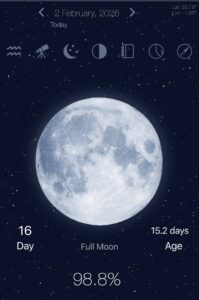
By the 2nd of February, the moon’s visibility has dropped to less than 100%, but not by very much. In fact, although this is technically a waning gibbous moon, it’s still round and fat enough to be classed as a full moon, especially for spiritual purposes. By the 3rd, the moon is about 98% visible, and you should notice an egg-like quality. In the Northern Hemisphere, the waning moon is shadowed from the right-hand side, while the left-hand edge remains circular and round.
What To Do During Each Phase of Imbolc’s Moon
Imbolc is an Irish fire festival, much adopted by various versions of the Wheel of the Year or simply celebrated in its own right. It comes not in the full flow of spring, but as the first stirrings are just starting to show. For me, it’s all about spotting those first crocuses, the occasional snowdrop, watching squirrels rediscover caches in the garden (usually in my plant pots!), and even the first buds of tantalising green.
If winter is a holding pattern, Imbolc is like a “Get Ready” nudge. The thaw is coming; the warmth is coming; change is on the way. Tuning into this festival and the season can help you find the energy to make similar changes in yourself.
Full Moon
February’s full moon is sometimes known as the Snow Moon, and that name has roots on both sides of the pond. Other names commonly associated with indigenous Americans include the Hungry Moon and the Bear Moon, referring, respectively, to the lack of fresh food sources and the time when bear cubs start to be born. Other names may include the Storm Moon and the Ice Moon.
Here in England, I think Storm Moon is apt, especially as we tend to have some pretty rough weather around this time of year. With that in mind, this full moon can be about battening down the hatches and ensuring you’re nurturing what you need and letting go of that which you really don’t.
With Imbolc being about rebirth and growth, prepare yourself for the year ahead in much the same way as you would a garden or allotment. Clear out the dead wood and prepare for new shoots. This can be as simple as meditating on your goals for the year, physically decluttering, or taking steps to further goals already in motion, such as applying for a new job or starting a new spiritual practice.
Take the time to celebrate your achievements and, if you like to be social, gather with people who you truly feel comfortable with and want to remain close to as you move into the warming season.
Related Reading: Learning Lunar, The Full Moon
Waning Gibbous
You can solidify your attempts to let go of unwanted baggage during the waning moon, which is, in many traditions, seen as an ideal time for banishment. Banishment doesn’t have to be dramatically sending someone out of your life. It can mean saying goodbye to a bad habit, moving on from something that’s holding you back, or even taking a bag of clothes to the local charity shop or thrift store. Sometimes these banishments can be symbolic, such as writing something you’re peeved about down on a piece of paper and letting it burn or burying it. Always work safely with fire!
Related Reading: Learning Lunar, The Waning Gibbous Moon
Astrology
My astrology information comes from AstroSeek’s Moon Calendar, as this is not my realm of expertise. Feel free to add your own thoughts and knowledge in the comments. Other readers will no doubt find your insights useful.
February’s full moon is in Leo, associated with enjoying the praise and admiration of others. This could make it an excellent time for a boast and a brag, but remember to take less-than-positive feedback on board too and to use it for self-improvement, not self-beratement. Café Astrology notes that the Aquarius sun sign at the same time creates a polarisation between the deeply personal and the impersonal, and another conflict between the powerful individual and the benefits of being part of a team. High emotions may cause these conflicts to come to the surface, but by being honest and expressing feelings openly, problems can be avoided.
During the waning moon, you can feel more sensitive to criticism while still under the influence of Leo. However, by the 3rd February, the moon has moved into Virgo, which encourages you to find safety in order and by seeking emotional clarity. Focusing on tolerance of minor imperfections could help you focus on the big changes you actually need to make in your life.
Magic
What type of magical path do you walk? Let this guide your moon rituals and routines, in line with the celebratory time of Imbolc or, if you don’t follow this type of wheel of the year, the hopeful signs that spring is on the way.
Group rituals can always be very fulfilling around the full moon and into the waning phase. Consider group goal setting, or toasting your achievements from the previous month, season, or year, as you plan for the year ahead. Share what you’ve seen of the stirrings of spring already, and what you’re looking forward to most about the new season.
If you honour the Goddess Brigid at this time of year, as many do, consider making offerings to Her. These may include ewe’s milk or oatcakes, or something more creative like a song or a poem. A candle is always appropriate, and I sometimes use melting snow or ice on my altar at this time of year.
Imbolc is also associated with cleansing and bathing (thank you to the Irish Pagan School again for this knowledge) so ritual bathing is appropriate. If you already do full moon bathing or full moon water meditation, such as meditation in the bath or the shower, add in your hopes, prayers, or thoughts for Imbolc.
The Moon And February
February, where I live, is still a cold and frigid time of year. We have had a “false spring” already, where warm air tricks us into thinking a thaw is coming, only to be replaced by blasts of wintery woe, often dubbed as the “Beast from the East.” We know that winter still stalks the Earth, but spring is truly around the corner. Folklore suggests that the Cailleach may come and stay for longer if it’s bright on Imbolc; all the more reason to pick the day you celebrate carefully! Stay warm, and enjoy the coming festival, whatever it means to you.
…………………………………………………………………………………………..
About the Author
Mabh Savage is a Pagan author, poet and musician, as well as a freelance journalist and blogger. She’s a nature-based witch, obsessed with Irish and British Paganism and Folklore, plus she’s a massive plant and bird nerd. She’s also a long-time Hekate devotee and a newbie Lokean. She works extensively with the UK Pagan Federation, including editing their bi-annual children’s magazine, Aether. Mabh is a passionate environmentalist and an advocate for inclusiveness and positive social transformation.
Mabh is the author of The Magic of Birds, a beginner’s guide to bird spirituality, symbolism, and many more aspects of everyday magic. She’s also written several other books: A Modern Celt: Seeking the Ancestors, Pagan Portals – Celtic Witchcraft: Modern Witchcraft Meets Celtic Ways, and Practically Pagan: An Alternative Guide to Planet Friendly Living. Search “Mabh Savage” on Spotify and @Mabherick on all socials.
Image credits
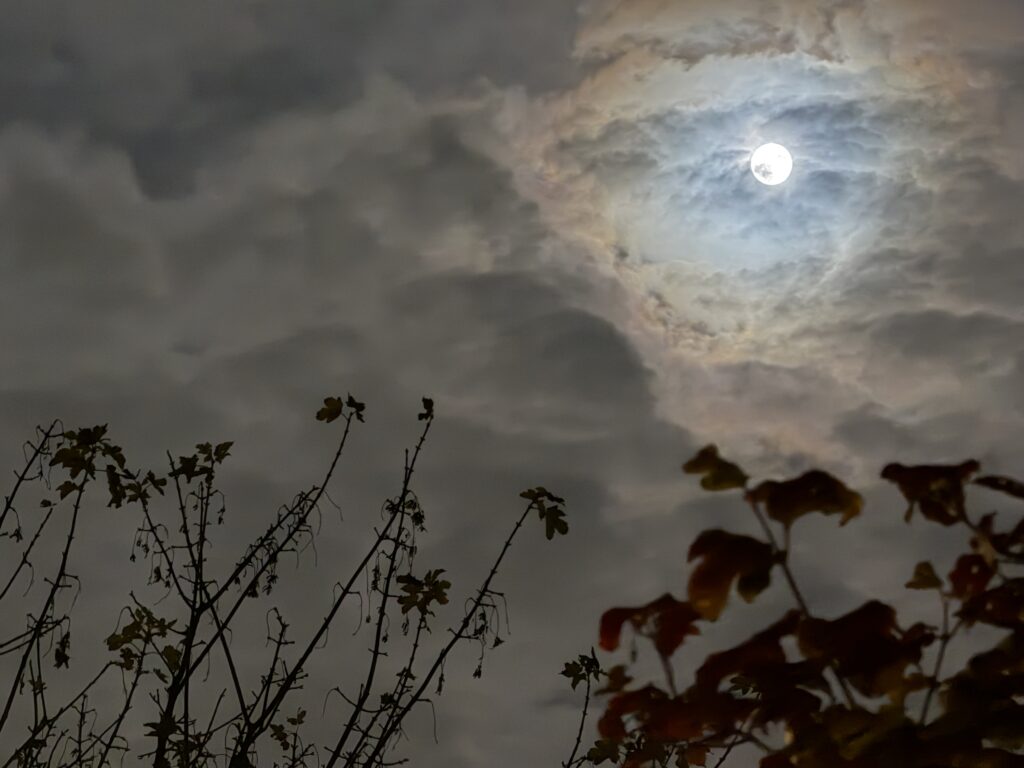
Full moon in clouds above wintery trees by Mabh Savage, © 2025, all rights reserved.
Screenshot of 98% visibility waning gibbous moon from iPhone app, The Moon. Taken by Mabh Savage.
Full moon in clouds photo by Ganapathy Kumar on Unsplash
Image alt text
A full moon in a dark sky, creating patterns in the clouds above a stand of thin, wintery branches.
A screenshot of an app showing the date of February the second, and an image of the waning gibbous moon in the Northern Hemisphere, and text that indicates the moon is between 98% and 99% visible.
A full moon, casting silvery light on a thin layer of surrounding cloud against a dark sky.