Sacred Places, Sacred Spaces
The Temple of Dendur/Dendura/Denderah
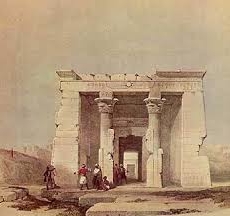
(Photo credit: touregypt.net)
This beautiful shrine which honors the Goddess Isis, was part of a larger temple dedicated to Hathor.
It was originally built on the left bank of the Nile in Nubia during the reign of Augustus Caesar. It was dedicated to both Isis and Osiris to honor the sons of a local Nubian chief.
It is also called “Per Rekh en Iset”, meaning “The Place of Knowing of Isis”.
The shrine, which stood on a wide stone platform, is small with three rooms, but extremely powerful. There is a portal with a front court and an inner sanctuary.
There are carvings of the king making offerings to Isis, Osiris and Horus, whom are holding ankhs and scepters. The king in this case was Augustus himself, because, as we know, Rome ruled the world. Augustus had himself carved into the Temple in the traditional dress of the Pharoah and his name was in the nearby cartouche. This carving was repeated twice more on the outside of the Temple and in the first chamber.
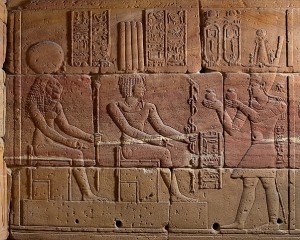
(Photo credit: metmuseum.org)
There are more carvings on the door frame leading to the inner sanctuary.
The only other carvings are on the door frame leading to the sanctuary of Isis. On the backwall is an image of offerings being made to the Goddess of Ten Thousand Names.
The base of the Temple is lined with carvings of lotus plants and papyrus, which were symbols of Hapy, the Nile God. The ceiling of the entrance is decorated with vultures with outstretched wings, symbolizing the sky and above the gate is the image of the moon with wings.
The original colors were said to be vivid, but were washed away by rising waters.
Many of these ancient temples are either no longer in existence or we would have to travel great distances to see them. Those of us in the United States are fortunate in that we have the opportunity to see the Temple of Dendur in all its’ powerful beauty. Because of the afore-mentioned rising waters, the Temple was dismantled and moved to New York City, all 800 tons of it, at a cost of $9.5 million. It has been in the Sackler Wing of the Metropolitan Museum of Art since 1978.
I have been to see the Temple at the museum on several occasions. As you exit the Egyptian galleries, you come upon a beautiful room with a glass wall. On the opposing wall are panels describing the moving of the Temple from Nubia to New York City.
The middle of the room is dominated by the Temple. The energy emanating from it is palatable. You can walk through the portal and up to the shrine itself, but cannot go further than the front court. When I was last at the museum, there were benches where you could sit and just take it all in. There is also a reflecting pool in front of the Temple itself.
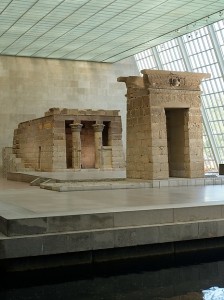
(Photo Credit: metmuseum.org)
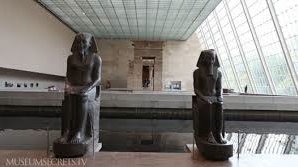
(Photo credit: museumsecrets.tv)
If you ever find yourself in New York City, please make time to visit the Met, which is, in itself, an amazing place, but the Egyptian galleries are amazing and when you are done, you will find yourself standing before an Isis Temple out of history. Feel the powerful energy of this Sacred Place/Sacred Space for yourself.