Signs & Omens July 2026 – Where Divination Began: A History from the Bone to the Bird
Long before anyone wrote down the word for it, people were already reading the world. The problem for anyone who wants to tell the history is that the practice is much older than the record of it. Divination almost certainly reaches back into prehistory, into a human past that left us no texts, only objects. So a true history cannot begin where divination began. It has to begin where the evidence begins, and the evidence begins in bone, entrail, and clay.
This is the first installment of Signs & Omens. Since we are only now meeting, a brief word about who is writing. My name is Kat Marshall, and I am a Hekatean witch, a druid and lifelong nature practitioner, a Hellenic polytheist, and a Master Gardener and herbalist of some thirty years. My own love is augury, the reading of birds, but this column means to range across the whole inheritance of the practice, and I wanted to open it by setting the practice on its actual historical footing rather than the vague “ancient peoples believed” that so much pagan writing settles for. Here is what we can actually say.
Before Writing: The Bone
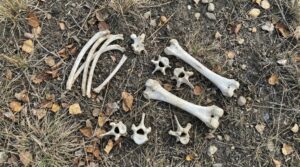
The oldest forms of divination we can point to physically did not involve birds, stars, or cards. They involved fire and bone. In Neolithic northern China, diviners took the shoulder blades of deer, sheep, pigs, and cattle, applied heat until the bone cracked, and read the future in the branching fractures. This technique, called pyro-scapulimancy, or divination by heat-cracked bone, has archaeological evidence stretching back to the fourth millennium BCE.
One sheep or deer scapula bearing deliberate burn marks has been radiocarbon-dated to roughly 3321 BCE, and the practice appears to have taken root across north China in the latter half of that millennium, becoming common by the end of the third. These earliest bones were uninscribed; the diviners were reading the cracks, not writing on them. Reading turtle shells the same way, called plastromancy, seems to have emerged somewhat later, around 2000 BCE.
The practice of reading bones for omens was not unique to China. Some form of it has turned up across much of the world, from Eurasia to Indigenous North America. What was distinctive about the Chinese tradition was the use of fire to force the sign, and it is that branch of the practice that would, more than two thousand years later, produce the oldest writing in East Asia.
We’ll return to China later. The point is this: humanity’s earliest recoverable divination was a reading of the body of a sacrificed animal, on the premise that the gods inscribed their answer in flesh and bone. That premise turns out to be remarkably durable.
The First Written Record: Mesopotamia
Writing was invented in southern Mesopotamia more than five thousand years ago, in the cuneiform script of Sumer. Here is a fact that surprises most people, and one I had to correct in my own assumptions: divination does not appear in those earliest texts. The first cuneiform tablets are overwhelmingly administrative – receipts, ration lists, accounts. Written omen collections do not show up until more than a thousand years after writing itself, becoming a recognizable genre in the Old Babylonian period, roughly 2000 to 1600 BCE. The tablets, in other words, record a practice that was already old when scribes finally committed it to writing.
What they recorded was, above all, extispicy: divination by the entrails of a sacrificed animal, and most especially the liver, which the Babylonians regarded as the seat of life and the soul. The specialist who performed it was called the b?rû, the inspector or seer, one of the most respected scholars at court. A sheep was sacrificed, a question was put to the gods, and the answer was read in the size, color, markings, and shape of the liver and lungs.
We know this because we have the diviners’ own teaching tools. Museums hold clay models of sheep livers, marked into labeled zones, each section noting what a particular blemish in that spot would mean. The British Museum’s famous example, probably from the city of Sippar, dates to the Old Babylonian period, about 1900 to 1600 BCE, and earlier models survive from the city of Mari on the Euphrates. One Mari model even references a past liver’s appearance at the time of a rebellion against King Ibbi-Sin of Ur – a divinatory record kept the way we might keep a case file. Similar liver models have been excavated at Hazor in modern Israel and at Hattusa, the Hittite capital in modern Turkey, where dozens were found. This was an international science.
Mesopotamian diviners did not stop at livers. They watched the sky. The great celestial omen series Enuma Anu Enlil – seventy tablets cataloguing the ominous meanings of the moon, sun, planets, and weather – was compiled around 1600 BCE from older traditions, and it is a direct ancestor of astrology. They also catalogued the omens of ordinary life in a series known as Šumma ?lu, “If a City,” compiled across the later second and first millennia: what it meant if a fox ran through the town, if a house cracked a certain way, if particular animals behaved strangely. By the seventh century BCE, the royal archives of the Assyrian kings at Nineveh preserved not just these reference works, but the actual working correspondence – the queries put to diviners and the answers returned to kings like Esarhaddon and Ashurbanipal.
The Babylonians themselves recognized a distinction that the Roman Cicero would echo centuries later: between divination that is learned and computed – the trained reading of livers, stars, and signs by a system – and divination that arrives unbidden, through dreams and inspiration. Nearly every later tradition, mine included, holds some of both.
If you want to read further on this period, the foundational modern scholarship is Jean Bottéro’s work on Mesopotamian religion and Stefan Maul’s The Art of Divination in the Ancient Near East. They are the real thing, not the recycled summaries that circulate online.
Egypt: The Message in the Dream
Egypt, Mesopotamia’s great contemporary, leaned toward a different channel. The Egyptians practiced hepatoscopy and other techniques, but their signature contribution to the history of divination is the dream.
The oldest surviving dream manual we possess is Egyptian: the Ramesside Dream Book, preserved on a papyrus known as Chester Beatty III, which dates to the thirteenth century BCE, around the reign of Ramesses II. Its translator, Alan Gardiner, argued that the text itself may have been composed even earlier, in the Middle Kingdom.
The book is laid out as a long list. Each entry begins with the same phrase about a man seeing himself in a dream, describes the dream, marks it as good or bad, and gives the interpretation. There is something on the order of 139 favorable dreams and 83 unfavorable ones, read by trained lector priests. Egyptians also slept in temple precincts on dream-beds, deliberately seeking a divine message in sleep, a practice of dream incubation that the Greek world would later raise to an art in the healing sanctuaries of Asklepios.
China Again: When Divination Invented Writing
Return now to those heat-cracked bones. By the late Shang dynasty, roughly 1250 to 1046 BCE, Chinese diviners had refined bone divination into a royal institution. They drilled and heated ox scapulae and turtle plastrons, read the cracks, and then carved the question and its answer directly onto the bone itself.
Those carvings are the oracle bone inscriptions, and they are the oldest known form of written Chinese – the direct ancestor of the script in use today. It is a striking fact that in China, writing and divination were born in the same act. The need to record what the gods had answered is, quite literally, part of why the Chinese began to write. After the Zhou overthrew the Shang around 1046 BCE, bone divination gradually gave way to divination with milfoil, the yarrow-stalk method that underlies the Yijing, the I Ching, still consulted now.
The Inheritance Flows West
The system most pagans know best – Greek and Roman – arrives relatively late in this story, and it inherited a great deal. Hepatoscopy, augury, and the rest moved westward out of the Near East into the Etruscan, Greek, and Roman worlds.
In Greece, divination is already woven through the oldest literature we have. Homer’s Iliad, composed around the eighth century BCE, opens with the seer Calchas, who reads the will of the gods through birds. The Greeks adopted liver divination, too, and Plato remarked that it came to be held in higher regard than bird-reading. Above the practitioners stood the great oracles like the Pythia at Delphi speaking for Apollo, and the rustling oak of Dodona answering for Zeus.
Rome made divination a vital tool of the state. Roman augury, the formal observation of birds, could halt an election or delay a war. Their liver divination, haruspicy, was inherited completely from the Etruscans as one of the three branches of the disciplina Etrusca. Our single best ancient source on how Romans thought about all of this is Cicero’s On Divination, written in the first century BCE by a man who was himself a member of the augural college. The most famous Roman augury of all stands at the founding of the city in 753 BCE: Romulus and Remus each took a hill and watched the sky, and where Remus saw six vultures over the Aventine, Romulus saw twelve over the Palatine. Note the bird. Roman augury sits at the far end of a very long road that started in Neolithic bone.
What The Record Shows
Line up the evidence, and a few conclusions emerge. Divination is older than writing everywhere we look, so no culture can claim to have invented it. The same handful of methods – reading the body of an animal, reading the sky, reading the dream, casting and reading lots – arose again and again in places that had no contact with one another. And the techniques tend to be written down only once they are already old, which means the dates we can prove are always later than the practice they describe.
Underneath all of it runs a single conviction, as true on a clay liver in Sippar as on the bone in Anyang: that the world is not mute, that meaning moves through it, and that a trained, attentive person can learn the grammar of Nature. That conviction is the real subject of this column. When the robin meets my eye on a north-facing morning and lifts toward the west, I am standing at the end of a line of attention more than five thousand years long. The only task, and the one we will keep returning to here, is learning how to listen.
I am glad to be reading the signs alongside you.
Sources and further reading
- Jean Bottéro, Mesopotamia: Writing, Reasoning, and the Gods
- Stefan Maul, The Art of Divination in the Ancient Near East
- Kasia Szpakowska, Behind Closed Eyes: Dreams and Nightmares in Ancient Egypt
- David N. Keightley, Sources of Shang History: The Oracle-Bone Inscriptions of Bronze Age China
- Cicero, On Divination (De Divinatione)
- The British Museum (clay liver model, Old Babylonian, c. 1900–1600 BCE)
**
About the Author
 Kat Marshall is a practitioner-scholar working at the intersection of divination, magic, and embodied wellness. She writes Signs & Omens for Pagan Pages and is the author of the forthcoming As the Crow Flies, a guide to bird augury grounded in historical and cross-cultural sources. Her devotional life spans Hekatean, Hellenic, Druidic, Norse, and Mesopotamian currents, and her research background includes formal training in Greek Magical Papyri (PGM) theurgy and strategic sorcery.
Alongside her occult writing, Kat is a Reiki Master/Teacher and trauma-informed yoga practitioner who runs Adaptive Wellness with Kathleen Marshall, bringing a similar commitment to primary sources and lived practice into her work on nervous system regulation and Ayurveda. She lives on a small homestead in southeastern Wisconsin, where she tends land, animals, and an ever-growing library. Her Substack, Of Ashes and Flames, follows her ongoing work across both worlds.